.svg)
Why AI projects fail: the architectural anti-patterns guaranteeing production failure


95% of AI pilots never reach production. Here's the architectural mistake that guarantees you'll be in that statistic.
Ninety-five percent of generative AI pilots fail to deliver measurable P&L impact. This is according to MIT's NANDA State of AI in Business 2025. RAND Corporation confirms over 80% of AI projects fail outright, twice the failure rate of non-AI technology projects. This isn't about individual company mistakes. It's a systemic architectural problem that most teams don't see until it's too late.
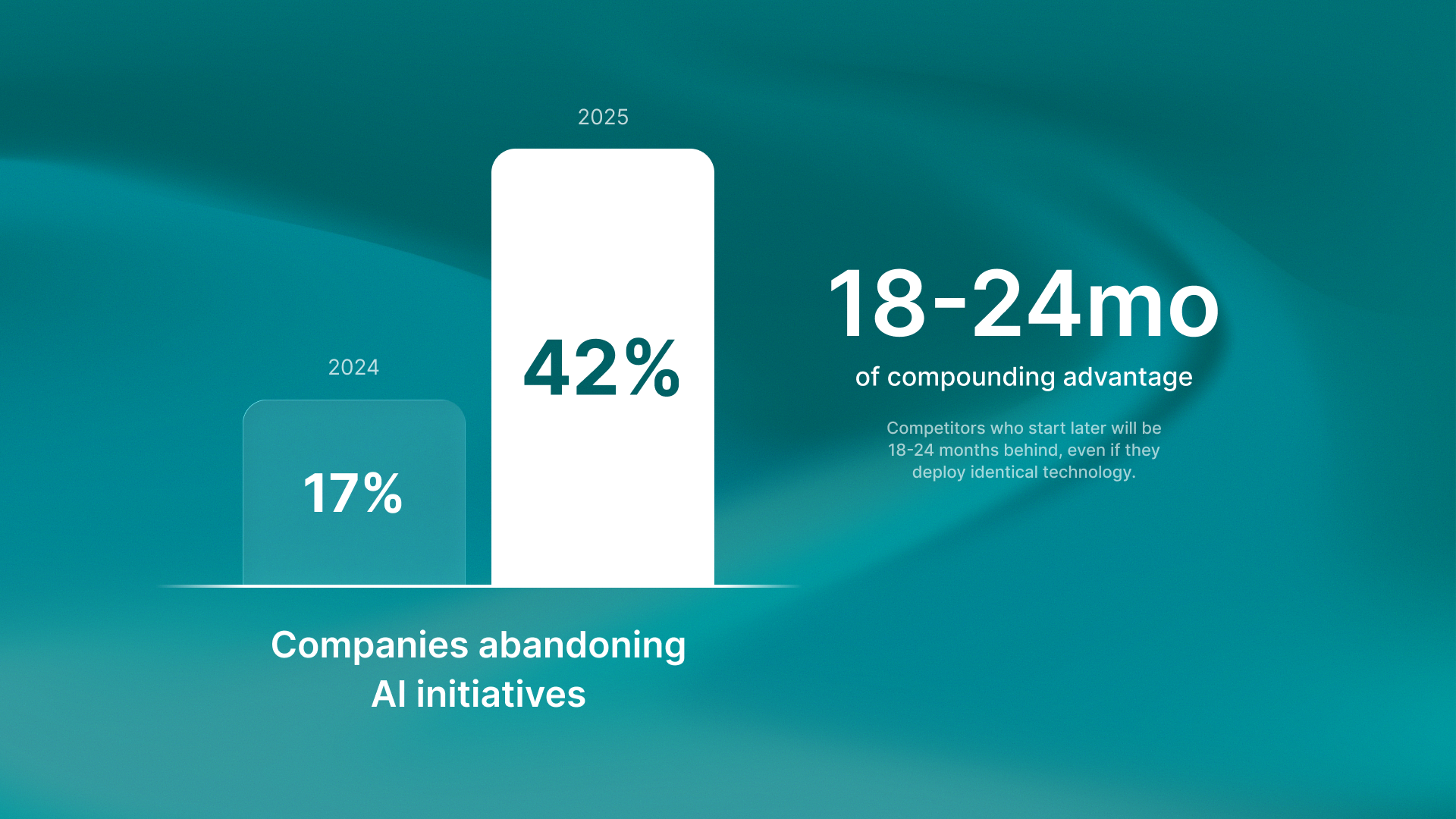
Here’s what we’re seeing across portfolio companies. AI projects that ship to production are built for production from day one. The ones that stall in endless pilots architect for impressive demos instead. WorkOS's 2025 Enterprise AI Analysis shows 42% of companies dropped most AI projects in 2025. This is up from 17% in 2024. Fast demo patterns help you build quickly, but they often fail in production. They can’t handle heavy workloads, edge cases, or autonomous operation.
The demo vs production architecture trap
Most teams optimize for speed to prototype. They build something impressive in weeks that executives can demo to the board. The problem is that the architectural shortcuts that enable fast demos guarantee production failure. Demo architectures skip error recovery, can't handle edge cases, and require human intervention at every decision point.
QA flow detects issues autonomously because it was architected with perception-reasoning-action-learning loops from day one. Projects that start as "AI-assisted" workflows need a full rebuild to become autonomous agents. In these workflows, humans complete every AI suggestion. The difference isn't incremental. It's foundational.
Assistant vs Agent: the decision that determines success
The assistant versus agent architectural decision determines whether your project ships. Assistants augment human workflows and require low-latency responses with high human oversight. GitHub Copilot suggests code completions. ChatGPT drafts content. Salesforce Einstein surfaces insights. All require humans to complete, review, or act on every output.
Agents replace workflows entirely. ReachSocial runs multi-week autonomous LinkedIn campaigns without human intervention. Shoreline monitors compliance continuously. The architectural requirements are fundamentally different. Assistants need fast response times. Agents need robust error handling and autonomous recovery systems.
Most failed projects we audited built perception (understanding context) and action (executing with APIs). But they skipped reasoning (planning multi-step workflows) and learning (improving from feedback). Without reasoning, the system can't handle complex workflows that span multiple steps. Without learning, it can't improve from mistakes or adapt to changing conditions. For more on this architectural distinction, see our breakdown of agentic AI vs assistants.
The cost architecture teams skip
The economic model shifts from research project to production system. You must architect for cost optimization, monitoring, and ROI measurement from the start or face expensive rebuilds. QA flow runs 2,400 test suites monthly at specific operational costs, eliminating multiple QA engineer FTEs. Projects that start without cost architecture can waste budgets on inefficient API calls. They may not show ROI to justify continued investment.
We cover real economics in detail in our AI agent cost and ROI analysis. The key insight is this: cost optimization is not something you add later. It's an architectural decision you make in week one that determines whether your project scales profitably.
What production architecture actually requires
Production AI agents require four architectural layers that demos skip. First, perception: understanding context from multiple data sources, not just single inputs. Second, reasoning: planning multi-step workflows with decision trees that handle edge cases. Third, action: executing through APIs with retry logic and fallback strategies. Fourth, learning: capturing feedback loops that improve performance over time.
These aren't optional features you add later. They're foundational architectural requirements. If you need a concrete playbook for implementing these layers, check out our 30-day guide to building your first AI agent.
The competitive window is closing
Companies that architect for production from day one will ship autonomous agents while competitors rebuild demos. The architectural decisions you make in week one determine whether you ship in quarters or years. Get the foundation right, and everything else gets easier. Build for demos first. You may spend the next 18 months rebuilding. Meanwhile, competitors can gain market share. They will ship features your architecture can't support.
For forward-looking predictions on where this technology is heading, see our 2026 AI agent predictions. The companies winning aren't the ones with the most impressive demos. They're the ones that understood production architecture requirements from the start.
Success Stories
Read more

.svg)
