.svg)


66% of companies can't measure AI agent ROI. Here's why: they're using the wrong formula.
Most engineering leaders use traditional tech ROI frameworks for AI agents. Then they wonder why the numbers don’t justify the investment. They calculate 7-12 month payback periods based on productivity gains, then watch their board presentations fall flat. The problem isn't the technology. It's the measurement framework.
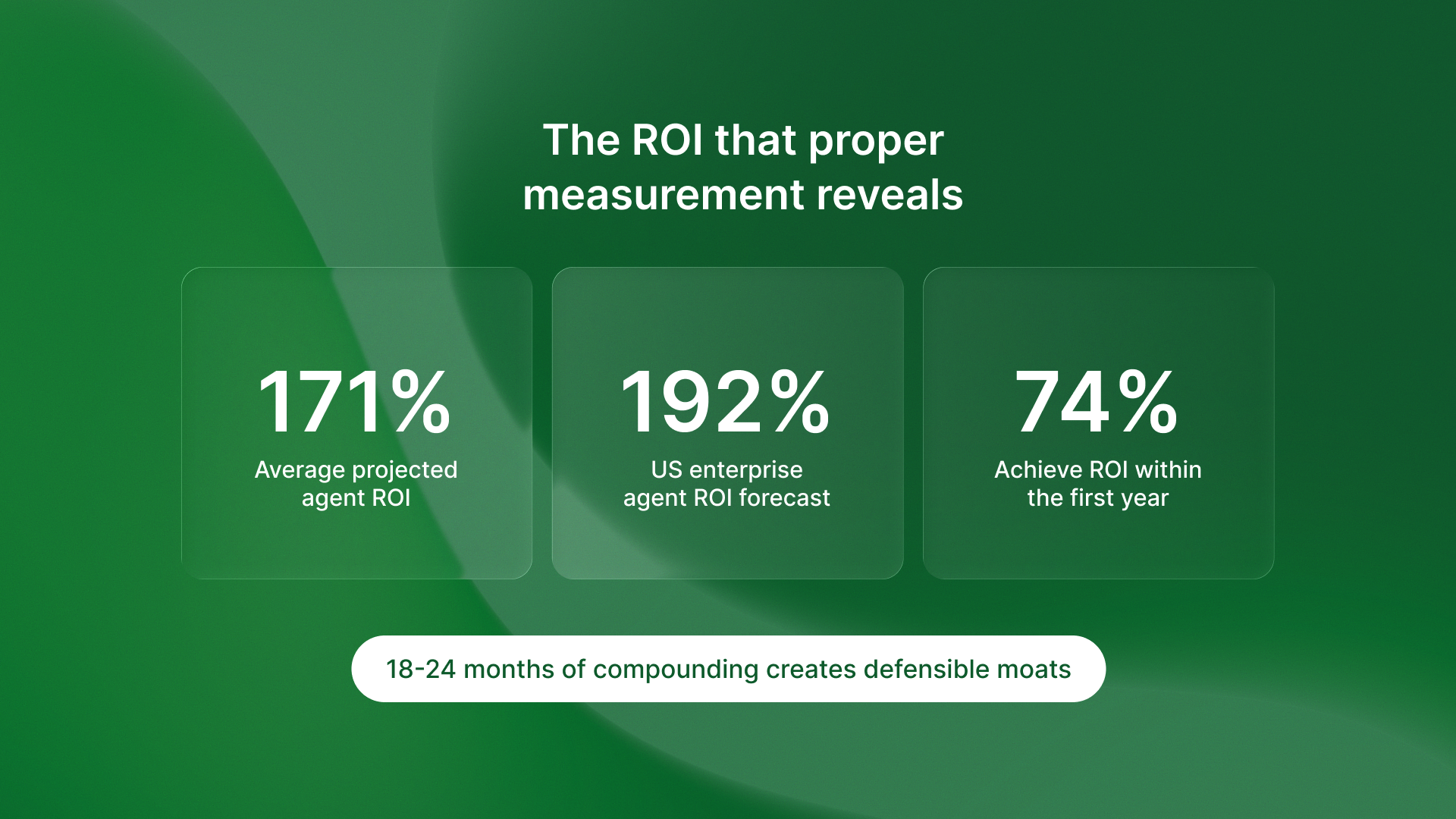
Here is what we see across our portfolio. Companies that track AI agent ROI measurement well average 171% returns. US enterprises forecast 192%. These aren't marginal improvements. They're business model transformations that traditional productivity metrics completely miss.
The critical distinction: assistants vs agents
The measurement problem starts with a fundamental misunderstanding about what autonomous systems actually do. Most companies treat AI agents like expensive assistants and measure them accordingly. They track hours saved, tasks automated, and productivity multipliers. This framework works perfectly for tools like GitHub Copilot or ChatGPT because those are assistants. They make humans faster at existing tasks.
Agents operate differently. They don't make workflows faster. They eliminate entire workflow categories. When QA flow detects bugs autonomously from Figma designs, it's not saving QA engineers time on manual testing. It's catching issues that would never have been found manually, enabling teams to ship faster with higher quality. That's not productivity improvement. That's capability creation.
74% of executives report ROI within the first year from AI agent deployments. This happens when they measure workflow elimination, not time savings. The companies struggling with AI ROI metrics are the ones still counting hours saved instead of workflows disappeared.
Why snapshot ROI calculations miss 60-80% of value
Traditional tech investments deliver linear returns. You buy software, it saves time, you measure the delta at month 6 or 12. AI agents don't work that way. They compound over time through data accumulation, process refinement, and expanding autonomy.
Production agents improve as they accumulate domain-specific data and refine decision-making. Early ROI checks show the first gains from workflow automation. But they miss the growing value as agents handle edge cases. They also cut error rates and expand into nearby processes. Organizations projecting 171-192% returns are measuring 24-36 month horizons, not quarterly snapshots.
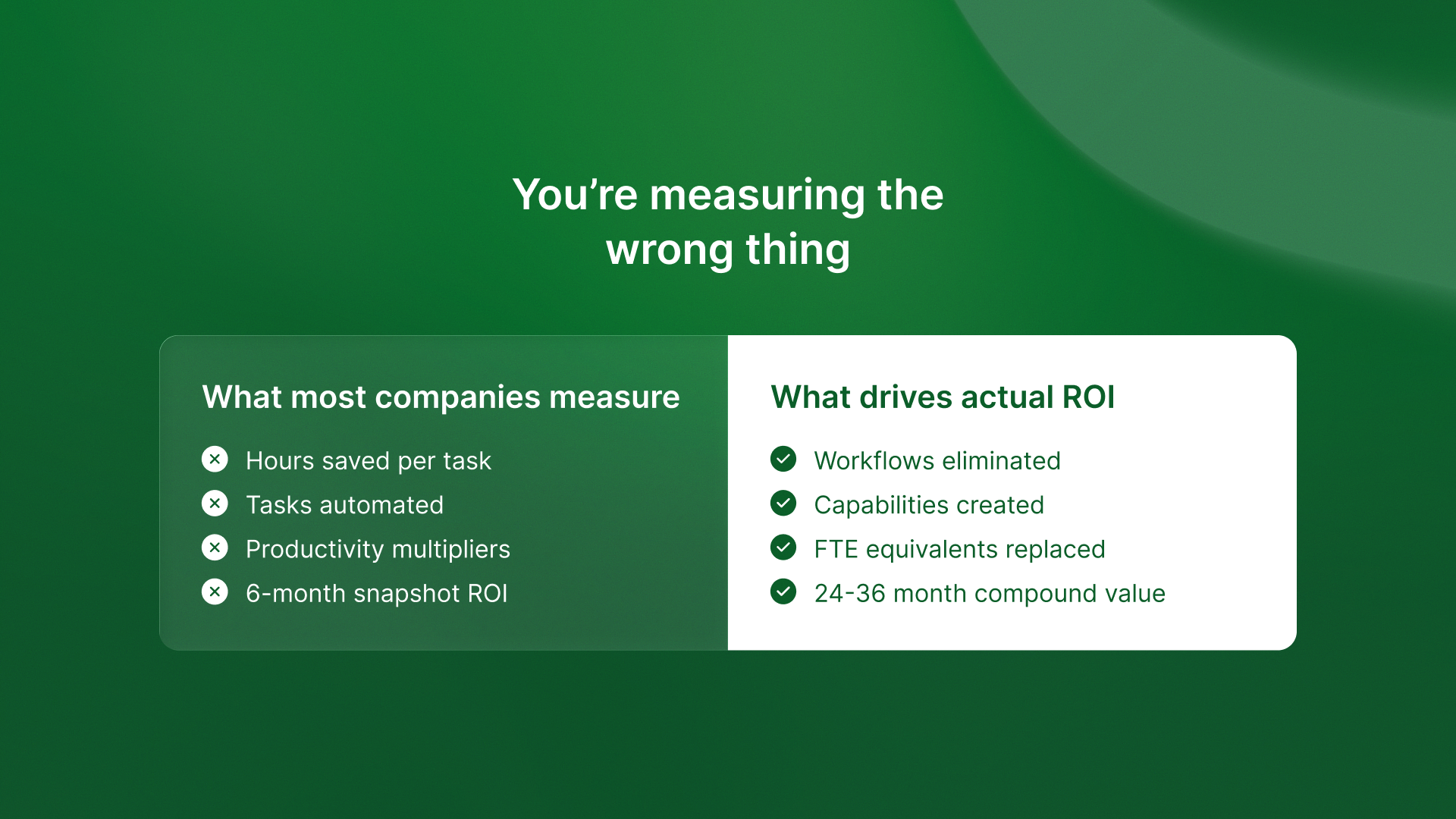
This is why traditional payback period calculations systematically undervalue autonomous systems. They measure the wrong outcomes at the wrong time horizons. Companies that get this right track FTE equivalents replaced and decision delays reduced. They also track fewer errors and new capabilities enabled. They do not track hours saved per task.
The board-level justification framework
Engineering leaders struggle to justify AI investment because they present technical metrics instead of business outcomes. API calls and token usage don't translate to board rooms. Customer acquisition cost reduction, time to market compression, and gross margin improvement do.
The measurement framework must connect agent deployment directly to business model metrics. Using tools like qaflow.com/audit, teams detect issues that would impact customer experience and conversion rates. That's not a technical win. That's CAC reduction through quality improvement.
Companies that achieve 192% ROI link agent rollout to clear business model changes. They lower CAC with automated sales workflows. They shorten product cycles with automated testing. They grow margins by removing unnecessary work steps. The framework translates technical capability into business value the board understands.
What this means for competitive advantage
Companies measuring agentic AI ROI correctly today are building 18-24 months of learning and refinement that creates defensible moats. While competitors optimize existing workflows with AI-enhanced tools, these organizations are building entirely new capabilities through autonomous systems.
The measurement framework isn't just about justifying current investment. It's about identifying which workflows to eliminate next and how fast competitive advantages compound. Organizations that start building now, with the right measurements in place, will collect domain-specific data. They will also refine processes that competitors cannot easily copy.
For more on the architectural difference that drives this ROI gap, see our breakdown of agents vs assistants. The companies winning with AI agents aren't optimizing existing workflows. They're building entirely new capabilities that traditional productivity metrics never capture.
Success Stories
Read more

.svg)
