.svg)

.png)
Your engineering team is 25% more productive. Your time-to-production is slower than ever. Here's why faster coding doesn't mean faster shipping.
The productivity paradox
CTOs are seeing a strange pattern. Developers report 20-25% time savings on debugging and refactoring with tools like Cursor (Opsera 2025). Individual productivity metrics are up across the board. Yet features aren't shipping faster, and technical debt keeps growing. The problem isn't the tools themselves - it's that coding speed is only one variable in a complex equation. Studies show 30-50% productivity gains on routine development tasks with AI (Senorit 2026). But most organizations see little improvement in deployment speed despite these gains. Why? Because coding is just one part of the software delivery lifecycle.
The gap between individual task speed and overall system performance shows a key truth about AI tools. Local improvements can slow the whole system when the architecture is not right. This is the hidden cost structure that vendor narratives ignore, and it's costing companies millions in accumulated technical debt.
The hidden tax of AI-generated code
Here's what actually costs money. AI coding assistants can generate code fast.But without clear architectural guardrails, they can create a new bottleneck. The 20–25% time savings in debugging is offset by the need to debug AI-generated code. This code may not follow architectural patterns. It may also add subtle bugs that only show up in production. We've seen this pattern often at Islands with engineering teams. Code ships faster at first, but later fixes erase those gains.
This isn't theoretical. 78% of organizations now use AI in core development workflows. AI-skilled professionals earn about 40% more. Sources: McKinsey and Upwork via Medium, 2026. That's massive investment in AI development tools. Few companies calculate the total cost of ownership. This includes more testing. It also includes heavier code reviews. It includes extra work for architectural reviews.
The architecture-first approach
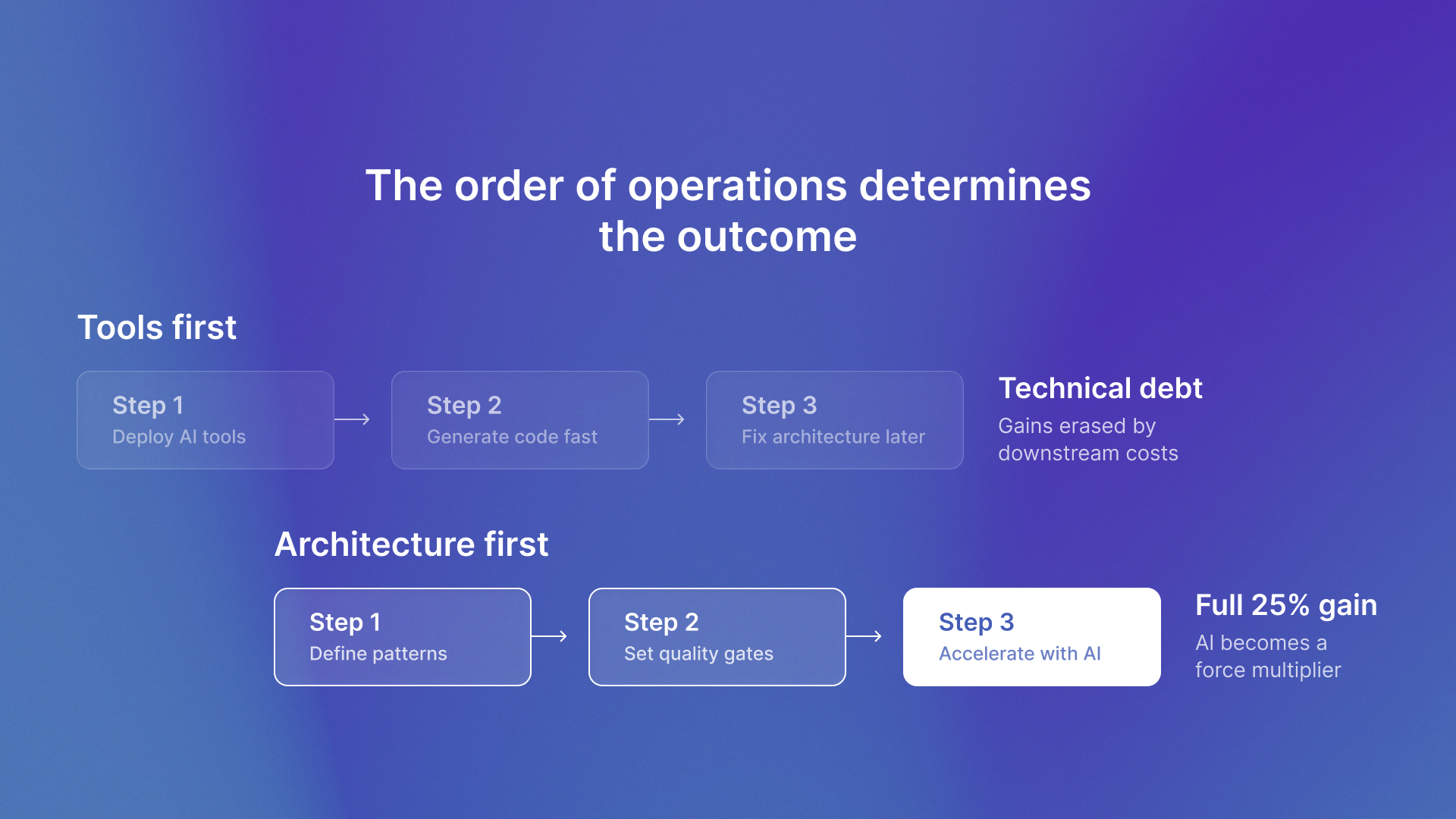
Companies winning with AI coding tools share a common pattern. They design for autonomous systems first. Then they use AI assistants to speed up building clear, proven patterns. The 30-50% productivity gains are highest on routine development tasks, which tells us something important. AI tools excel at execution within constraints, not architectural decision-making. They're accelerators, not replacements for architectural thinking.
This is why we built QA flow to automate testing from Figma designs. Autonomous agents need clear architecture boundaries to deliver value. The https://www.qaflow.com/website-audit This tool shows this principle. It finds issues like broken links and SEO problems. It works within clear architectural constraints. It does not make architectural decisions.
What this means for your team
Here's the strategic implication. Companies should design for autonomous systems first. Then they can use AI assistants to speed up work. This approach will capture the full productivity gains. Those who let AI tools drive architecture will pay the hidden tax in technical debt and slower deployment velocity. The gap between these two approaches will widen over the next 18 months as AI adoption accelerates.
For more on this architectural decision, see our guide to agentic AI vs AI assistants. It explains why system architecture matters more than the coding tools you choose.
When this doesn't apply
Two situations where faster coding without architectural discipline makes sense. Early-stage startups pre-PMF where speed to market matters more than architectural purity. And companies with exceptional architectural discipline already in place, where AI tools simply accelerate execution of proven patterns. For everyone else, the choice is clear: architect first, then accelerate.
Success Stories
Read more

.svg)
