.svg)
The real cost of production AI agents: infrastructure, APIs, and hidden operational expenses

AI infrastructure costs dropped 70% since 2020. A setup that required six figures now runs on $50-60 monthly (Altamira AI 2025). But most teams still blow their AI agent budgets by 3x because they plan for the sticker price, not the real economics.
The gap isn't a planning failure. It's a structure problem. AI agent development cost has three layers: infrastructure, LLM APIs, and operational overhead. Teams budget for infrastructure and discover the other two in production.
The three-layer cost structure nobody warns you about
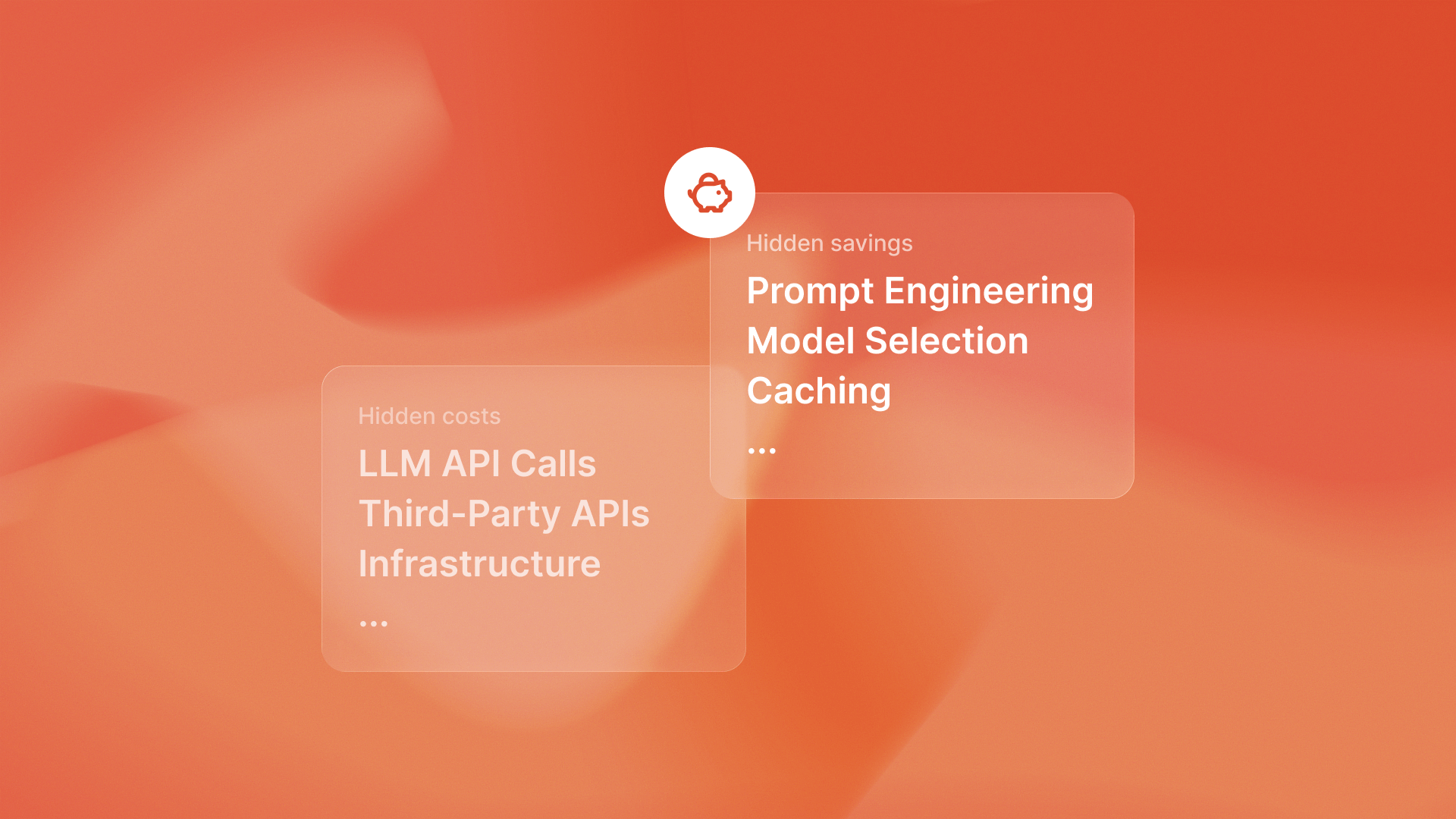
Layer 1 is infrastructure: cloud compute, storage, and hosting. This is what dropped 70%. Layer 2 is LLM API costs: token usage that scales with request volume. Layer 3 is operational overhead: monitoring, maintenance, and edge cases that emerge only after deployment.
Most cost estimates cover Layer 1. The real economics are in Layers 2 and 3. They change in ways you can’t predict and depend on production use patterns you can’t forecast from development.
Infrastructure costs: Democratization hype vs scale reality
The $50-60/month infrastructure narrative is real for demos and MVPs. It's not real for production. Cloud infrastructure costs range from $200 to $2,000 monthly depending on data volume and model size (Perimattic 2026). The variance comes from two drivers: how much data your agent processes and which models it runs.
A lightweight agent processing structured data at predictable intervals hits the low end. A complex agent handling unstructured inputs with variable request volumes hits the high end. Infrastructure optimization matters, but you can't cut your way to demo-level costs at production scale.
LLM API costs: the variable that breaks your model
LLM API costs are the dominant operational expense at scale, ranging from £1,800 to £10,500 monthly (Technova Partners 2025). This variance isn't a pricing tier difference. It's usage pattern unpredictability.
Token use in production differs from development because real users trigger edge cases, complex workflows, and request patterns you didn't anticipate. Optimization strategies exist: prompt engineering to reduce tokens, caching for repeated queries, hybrid approaches using GPT-4 for complex reasoning and GPT-3.5 for simple tasks. These reduce costs but don't eliminate unpredictability.
Maintenance costs add another 15-25% of the initial build cost annually (Perimattic 2026). This isn't optional overhead you can defer. It covers retraining models as data changes, updating infrastructure, monitoring for failures, and handling edge cases in production. Most teams underestimate this because development budgets don't include Year 2 costs.
A medium complexity AI agent costs £16,000 to £75,000 to implement, with £1,800 to £10,500 in monthly operational expenses (Technova Partners 2025). Low-end implementations use simpler models, limited integrations, and narrower workflows. High-end implementations require custom model training, complex integrations, and autonomous decision-making across multiple systems. Year 1 includes implementation plus 12 months of operational costs. Year 2 is operational expenses plus 15-25% maintenance.
The economics work when the agent automates high-value workflows at volume. They don't work when operational costs exceed the value of automation.
When to commit (and when to wait)
Companies that model all three cost layers before building avoid budget overruns. They know whether economics work at their scale before committing engineering resources. Teams that plan for $50/month infrastructure and discover $8,000/month in total costs six months later can't pivot without sunk costs.
The barrier to entry dropped. The barrier to production economics didn't. Companies that understand real AI agent economics make faster decisions because they're not surprised by operational costs in production.
Success Stories
Read more

.png)
.svg)
