.svg)
SR&ED and AI: How Much Can Your Startup Reclaim in 2026?

Key Takeaways
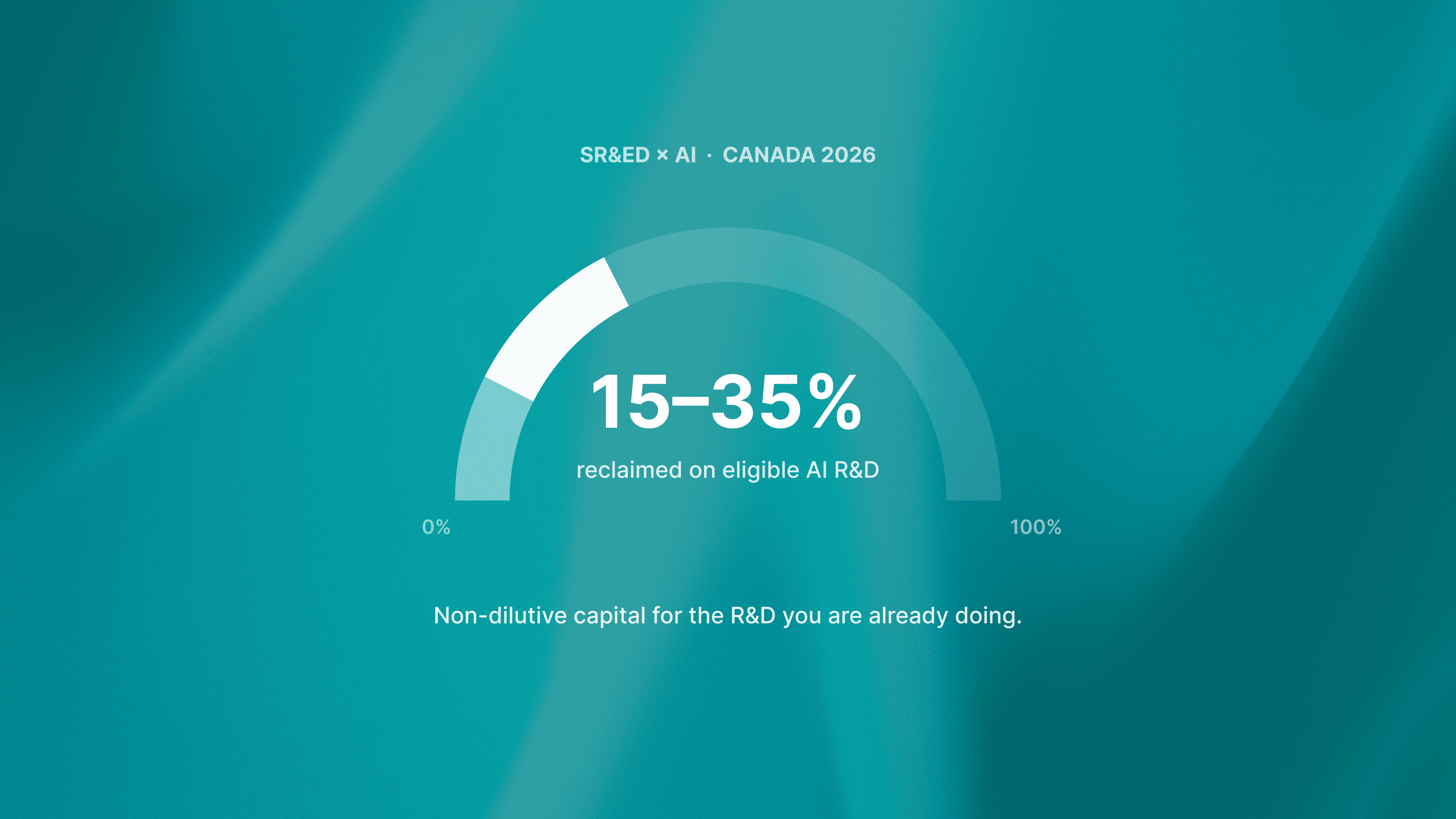
SR&ED can recover up to 35% of AI R&D costs. The refundable credit now covers up to $6M of spend, worth $2.1M a year federally.
1. 2026 brought big changes. The limit doubled, equipment is eligible again, and pre-claim approval lets you confirm eligibility before you build.
2. Series B companies should check their taxable capital. Above $15M, the enhanced credit starts to phase out.
3. FTEs and contractors are treated differently. 100% of eligible employee costs can qualify, while only 80% of eligible contractor costs are included.
4. Documentation wins claims. Log failed iterations and make sure your narratives match your Git history.
I was reviewing the R&D roadmap with a Series B founder last week when he started complaining about the "AI tax." He was referring to the massive compute and engineering costs required to build autonomous agents. In 2026, moving AI from a polished demo to a production-grade system is an expensive architectural feat. Effectively leveraging SR&ED and AI tax credits 2026 serves as a strategic financial lever to extend your runway while building proprietary systems.
What changed in SR&ED in 2026
Bill C-15 received Royal Assent on March 26, 2026, introducing significant changes to the SR&ED program. The changes apply to tax years beginning after December 15, 2024, so they likely cover the claim you're preparing now.
The enhanced credit limit doubled. The enhanced 35% ITC expenditure limit doubled from $3M to $6M. That's up to $2.1 million a year in refundable credits, before provincial credits.
The phase-out range widened to $15M–$75M in taxable capital. A big Series B raise can push you past $15 million and into partial-credit territory, so check before you model recovery.
Public companies qualify. Eligible Canadian public corporations can now claim the enhanced credit.
Equipment is back. Capital expenditures made after December 15, 2024, are eligible again, including GPU servers and inference hardware bought for R&D.
You can get approval before you build. Since April 1, 2026, the CRA's optional pre-claim approval lets you confirm a project qualifies before work starts. It covers eligibility, not expenses, so you still need full records.
The 2026 SR&ED landscape for AI startups
Understanding the 15-35% recovery range
For eligible Canadian R&D, the SR&ED investment tax credit can be calculated at rates including 15% and 35%, depending on the corporation and the nature of the qualifying expenditures. This recovery is not just a tax break: it is a reinvestment engine. For a Series B startup, managing production AI agent costs is critical, as infrastructure and error handling often comprise over half of the total spend. These AI R&D tax incentives ensure that capital can be the difference between shipping a product-led growth engine or stalling at the prototype stage.
Why 2026 is the year of the autonomous agent audit
As the market shifts toward workflow replacement, the CRA is focusing more on technical advancement. You cannot just wrap an API and call it R&D. You must prove you are solving deep architectural problems and accounting for autonomous agent development costs throughout the lifecycle. Startups that track SaaS spend benchmarks for R&D vs. G&A have a distinct advantage. These internal metrics help document engineering hours and resource allocation for audit compliance.
Maximizing eligible expenditures
How much is the SR&ED tax credit?
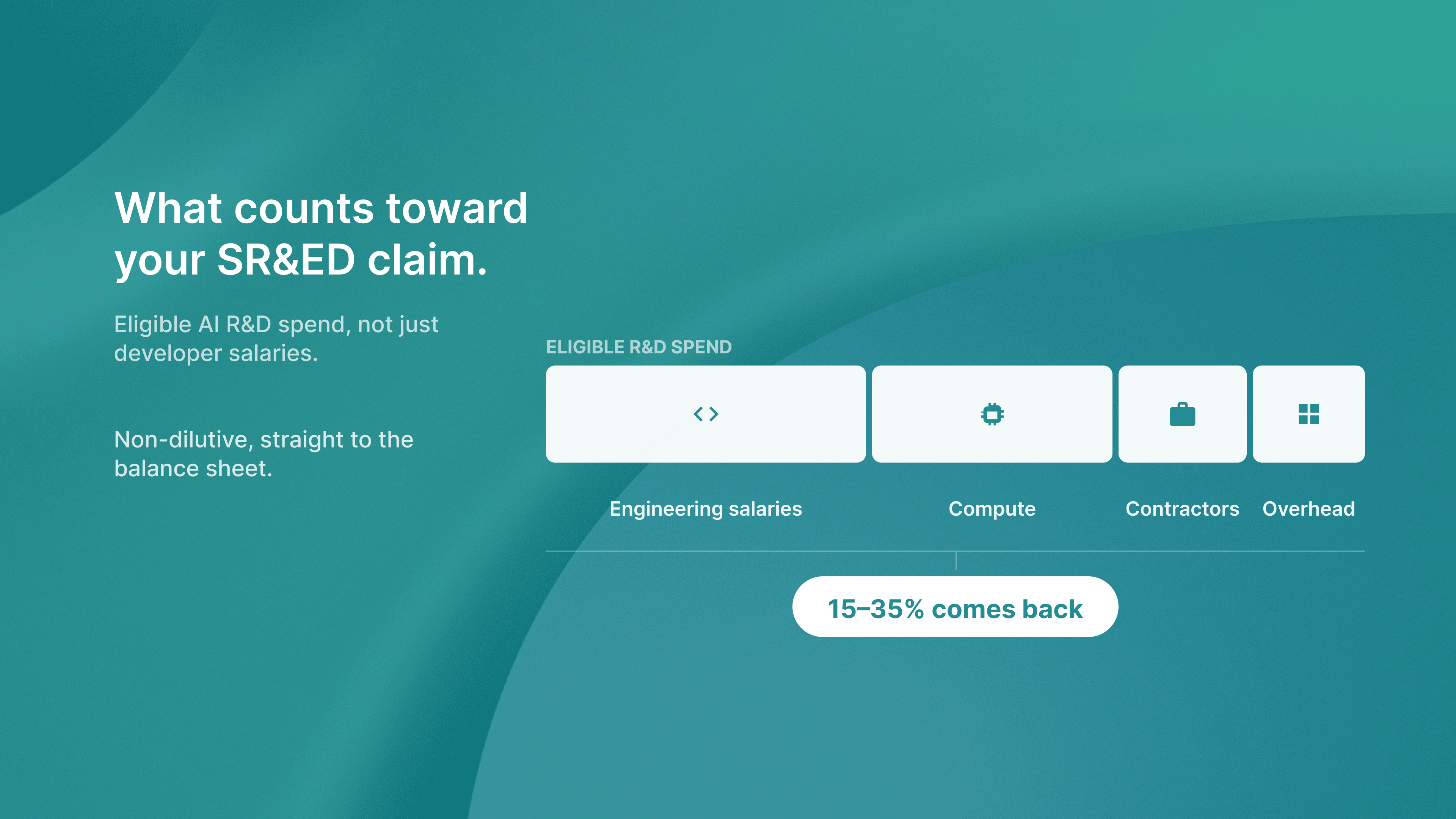
To maximize your claim, you must identify every eligible expenditure. This goes beyond just developer salaries. It includes the infrastructure that supports them. Many AI business cases fail because they ignore these production costs, making it harder to justify R&D intensity to auditors.
- Engineering salaries directly involved in R&D activities.
- Compute costs associated with training and testing models.
- Materials and overhead related to the R&D environment.
- Contractor costs for eligible SR&ED work may qualify, but generally only 80% of the contract expenditure is included in qualified SR&ED expenditures.
Defining scientific uncertainty in agentic loops
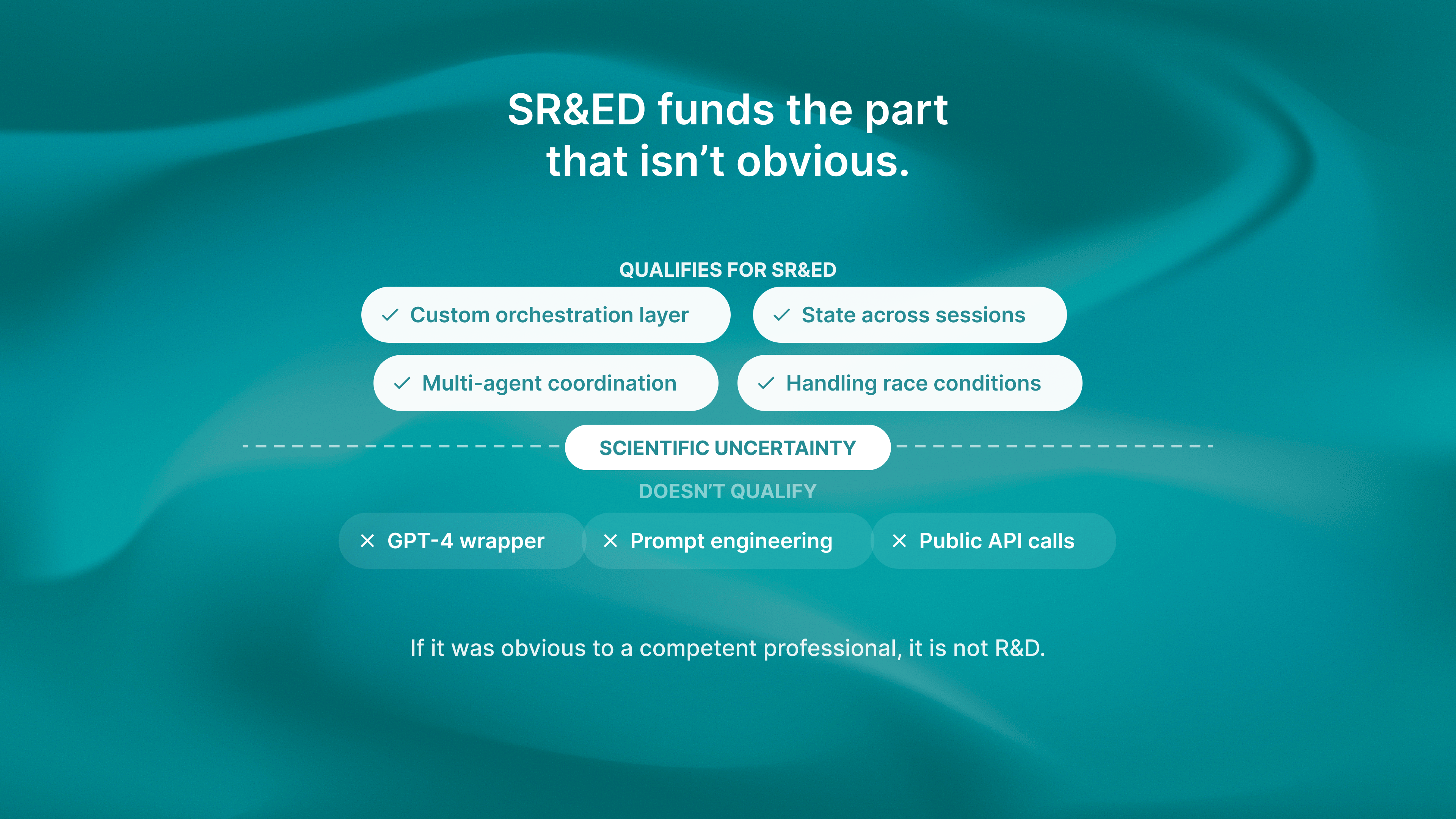
AI companies must demonstrate technical advancement and scientific uncertainty AI to qualify for the full investment tax credit. Startups often struggle with this because they rely on traditional productivity formulas that do not capture the technical complexity of workflow elimination.
Building autonomous systems often involves this exact uncertainty. How do you ensure the agent maintains state across disconnected sessions? That is a technical hurdle that qualifies for credits. Companies achieving a high AI transformation ROI typically document these hurdles meticulously from day one.
The roadmap: Maximizing your 2026 claim
- Identify projects that involve solving non-obvious technical problems.
- Document every failed iteration and architectural pivot in real-time by using a project profitability framework.
- Separate routine maintenance from genuine R&D engineering tasks to avoid measuring AI ROI incorrectly.
- Reconcile compute costs specifically linked to R&D experimentation.
- Conduct a technical audit before the final filing to ensure narratives match Git commits.
The bottom line
Treat SR&ED and AI tax credits 2026 as infrastructure, not just a tax filing. It is the financial bedrock that allows you to Build. Run. Maintain. your proprietary AI systems. Establishing a robust AI business case ensures your R&D efforts translate into both technical breakthroughs and maximum tax recovery.
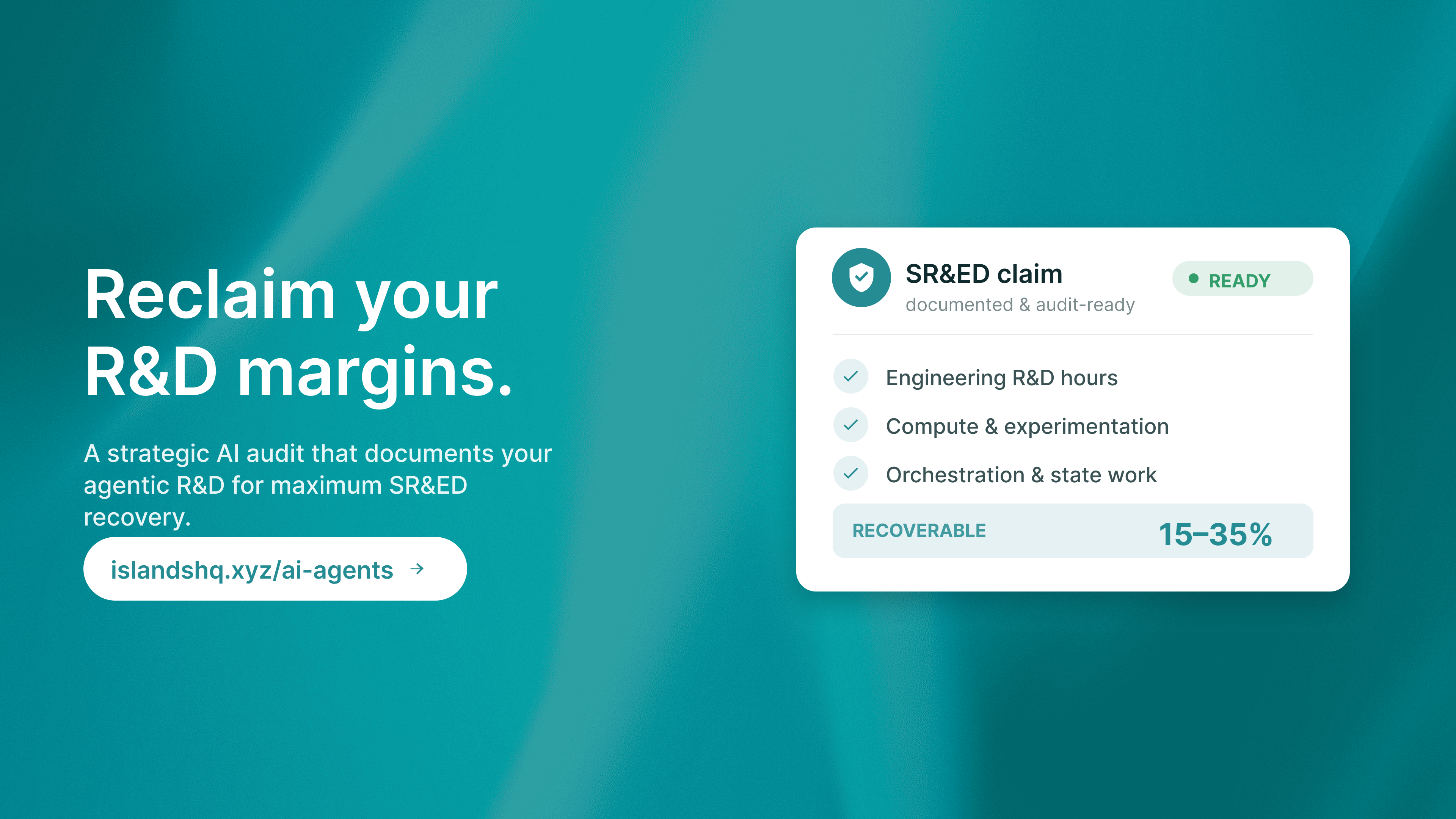
Reach out today to see how our strategic audit can help you reclaim your engineering margins and book a call with Islands to optimize your agent strategy.
Success Stories
Read more

.svg)
