.svg)


Search changed faster in the last eighteen months than it did in the previous decade. Google now shows an AI Overview for nearly half of all queries. More buyers now start research in ChatGPT, Perplexity, or Gemini, not a search bar. The job is no longer only to rank. The job is to get cited.
AI for SEO is how you do both. Used well, it shortens research, improves structure, and tracks where your brand shows up. It works across every engine that now answers questions. Used carelessly, it floods your site with commodity content that the January 2026 core update was built to bury.
This is the playbook we run across our own ventures and our content clients. It works because we operate these systems daily, then deploy what survives contact with real traffic.
What is AI SEO?
AI SEO is the practice of using artificial intelligence to research, create, and improve content.
It helps content rank in search results and get cited in AI-generated answers. It spans two jobs: making content extractable enough for machines to quote, and authoritative enough for them to trust.
Traditional SEO gets you ranked. AI SEO gets you cited. A well-structured page can appear in an AI answer, even if it is on page two or three. AI systems choose sources based on clarity and credibility, not rank alone.
AI SEO vs traditional SEO
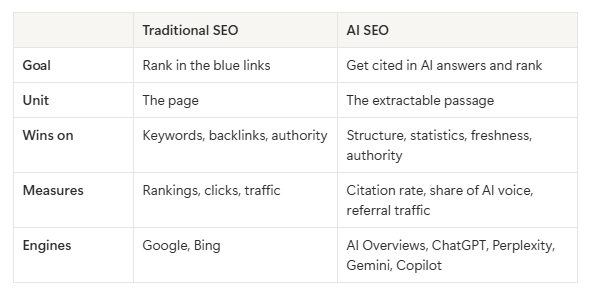
The foundation stays the same. AI search engines like ChatGPT and Perplexity use Google’s index as a base. So, strong technical SEO still helps you get considered. AI SEO adds a layer of structure and proof on top.
How to use AI for SEO: a 6-step workflow
1. Research intent, not just keywords. Point AI at the top-ranking results for a query and have it surface the questions, subtopics, and entities those pages cover. Pull real questions from Reddit and Quora threads so you write to intent rather than volume.
2. Build the brief before the draft. Generate a structured outline that maps headings to how people actually phrase searches. One clear target query per post, answered in the first paragraph.
3. Write for humans, structure for machines. Lead every section with a direct answer in 40 to 60 words. Use comparison tables for "X vs Y" queries, numbered steps for "how to" queries, and an FAQ block for the long tail. Keep one idea per paragraph.
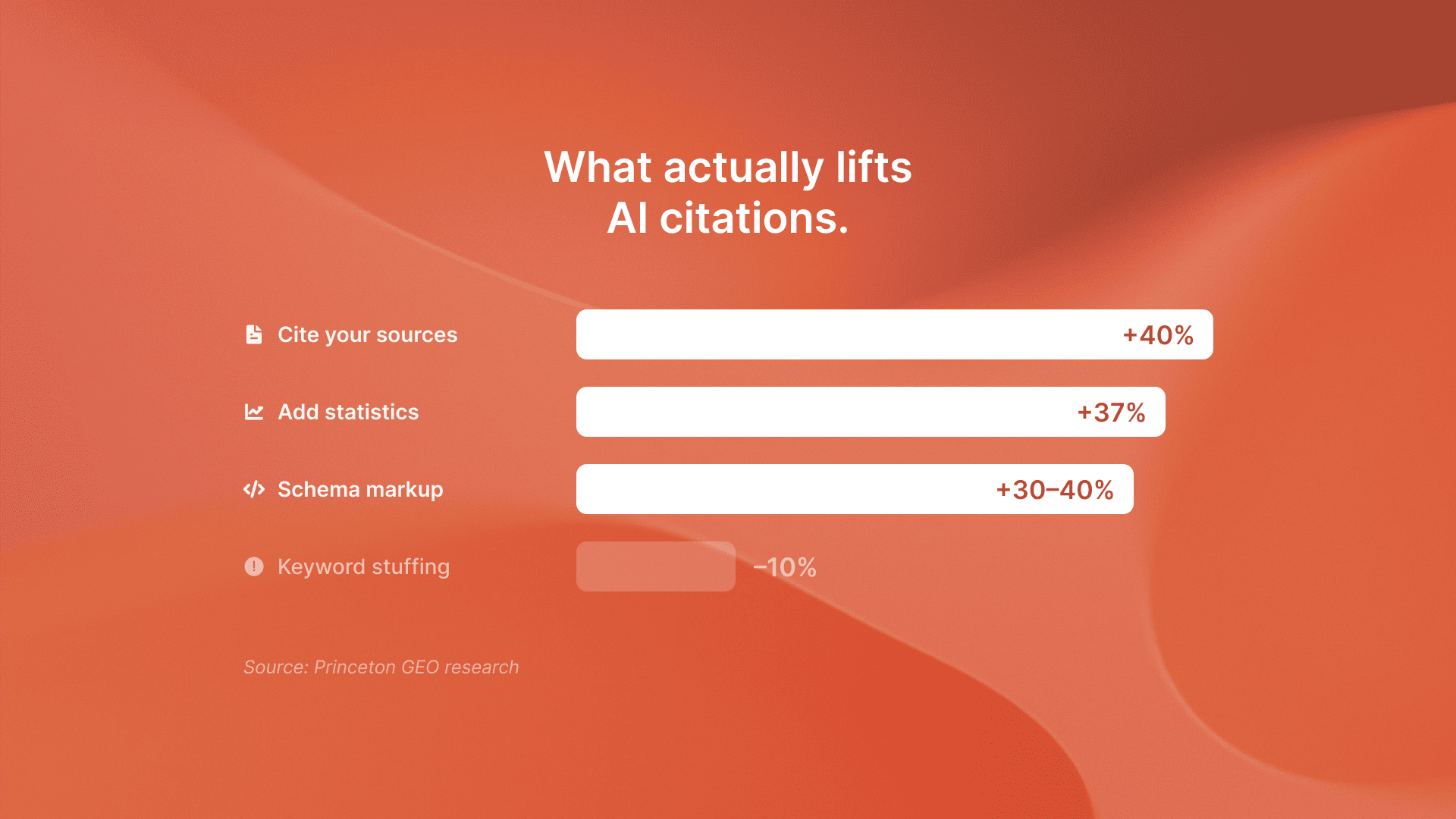
4. Optimize against the SERP. Score your draft against what already ranks, then add the entities, statistics, and sources that earn citations. Princeton's GEO research found that citing sources can boost AI visibility by about 40 percent. Adding statistics can boost it by about 37 percent. Keyword stuffing does the opposite and costs you around 10 percent.
5. Add proof and authorship. Attach a named author with credentials, cite original data, and stamp a visible "last updated" date. These freshness and expertise signals move the needle on whether an AI quotes you.
6. Track your AI visibility. Run your top 20 queries through ChatGPT, Perplexity, and Google monthly. Record whether you appear, who else does, and which page earned the mention. You cannot improve what you do not measure.
Do you need an all-in-one SEO platform?
Maybe. An all-in-one SEO platform is worth the cost when you manage many pages. It also helps when you track competitors. It keeps AI visibility data in one place. For most teams the calculus is simple: if a platform saves ten hours of manual research a month, it pays for itself. A solo site running on Search Console and a free model often does not need one yet.
Is an SEO plugin enough?
For a small WordPress or Shopify site, an SEO plugin covers the basics well. It handles title tags, meta descriptions, sitemaps, and schema. It will not research intent, score your draft against the SERP, or tell you whether Perplexity is citing a competitor. Treat the plugin as table stakes, then layer AI for the work it cannot touch.
The best AI SEO tools 2026
No single tool wins. The right stack depends on whether your bottleneck is content, technical debt, or AI visibility. Here is how the most-used platforms break down this year.
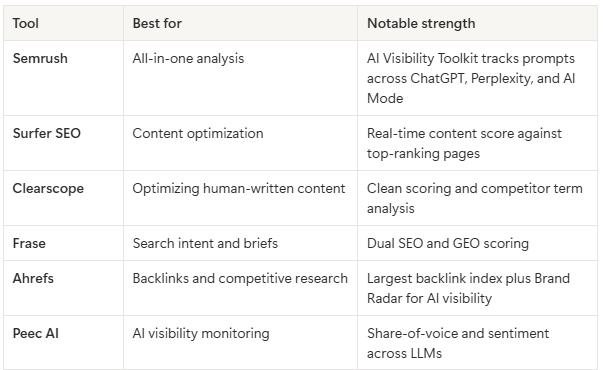
Pick for your bottleneck. A focused 100-dollar stack used well beats a 500-dollar stack you barely open. And check each tool’s data against Google Search Console before you trust it. GSC is the best source for indexation.
AI search engine optimization: optimizing for GEO and AEO
AI search engine optimization adds two new layers to SEO. Generative Engine Optimization targets citations in AI answers. Answer Engine Optimization targets featured snippets and voice results. Three moves carry most of the weight.
Structure for extraction. Self-contained answer blocks help search engines find clear quotes.
Use comparison tables in crawlable HTML, not images. Write headings as questions to help search engines find clear quotes.
Build citable authority. Original statistics, expert attribution, and transparent sourcing make your page the safe thing to cite. Schema markup such as Article, FAQPage, and HowTo lifts AI visibility by 30 to 40 percent.
Show up where AI looks. AI systems cite where you appear, not only your own domain. Brands are about 6.5 times more likely to be cited by third-party sources. So industry roundups, review sites, and active communities matter as much as your blog.
Where Islands fits
We do not hand you a tool and wish you luck. We build, run, and maintain AI systems in our own ventures first, then deploy the ones that work for clients.
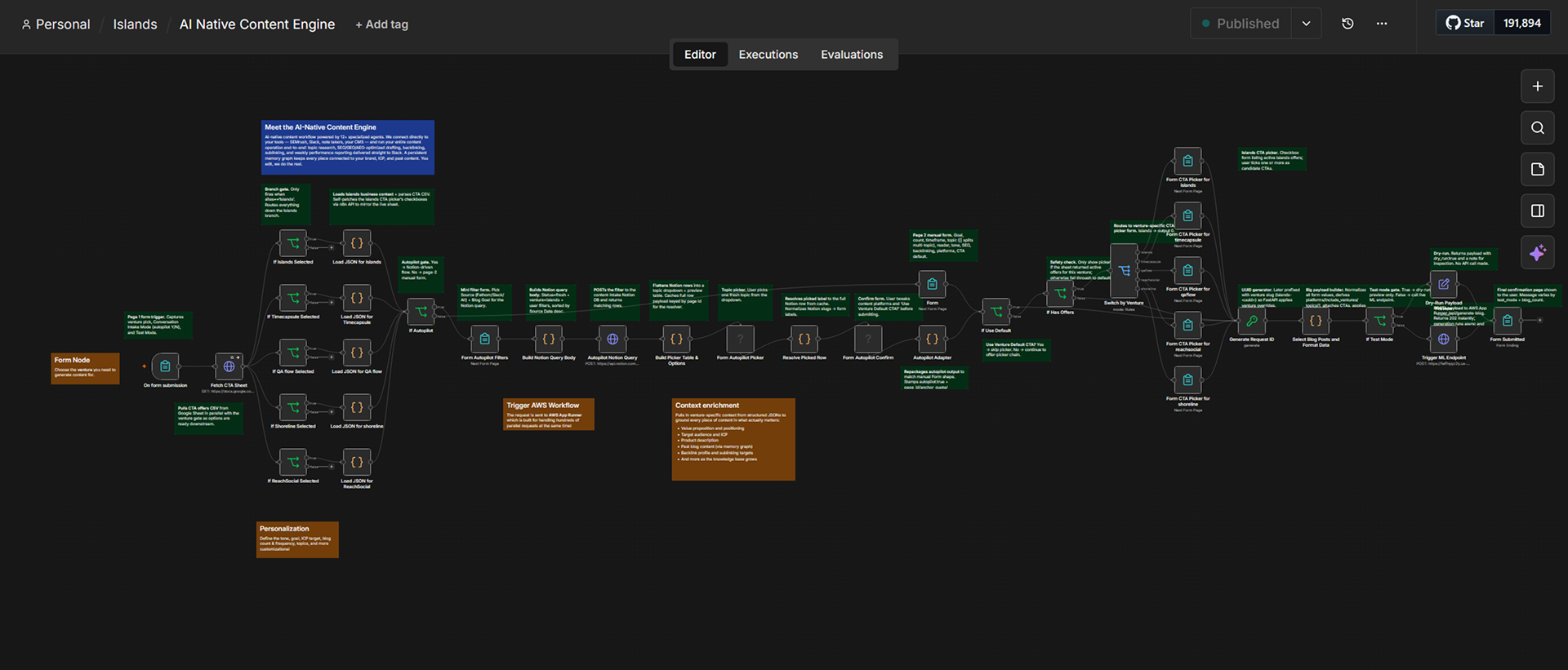
Our AI Content System runs the full pipeline from research to publish across every engine that matters. We pressure-test it on our own properties: an AI QA engineer in QA flow, LinkedIn growth automation in ReachSocial, time tracking in Timecapsule, and Canadian Employer of Record services in Shoreline. Canadian founders can also fund the work through our AI training grant advisory.
The same system already produces and ranks content for the brands we run growth for, including a direct-to-consumer beauty brand, a commercial floor-care company, a marketing talent marketplace, a financial services firm, and a performance marketing agency. Different industries, one operating model.
We build, run and maintain AI content engines. Here’s a glimpse of ours.
FAQ
Will AI content get my site penalized?
Not on its own. Google's 2026 updates reward helpful, experience-led content and bury commodity output. AI is safe when a human checks the work. The content should include proprietary inputs, like founder stories, first-party data, and real results.
Can AI replace an SEO team?
No. AI amplifies skill. A strong SEO becomes faster and sharper. Someone without the fundamentals just makes mistakes faster.
How do I get cited by ChatGPT and Perplexity?
Lead with direct answers. Add cited statistics and named experts. Mark up your content with schema. Allow AI crawlers in robots.txt and earn mentions on the third-party sources those engines already trust.
Does traditional SEO still matter in 2026?
Yes. AI engines use the search index. So technical health and authority still decide if you can be cited.
Ready to rank and get cited?
Islands builds, runs, and maintains the AI content engine behind your search visibility. This helps you ship faster and show up where buyers ask questions now. Book a call and we will map your AI SEO playbook.
Build. Run. Maintain.
Success Stories

.svg)
