TL;DR
- White-label AI content systems replace manual writing tasks with automated pipelines to maintain organic growth without increasing headcount.
- Traditional SEO agencies spend 60 percent of their time on manual work instead of high-level strategy.
- Founders should choose systems with specialized orchestration layers rather than simple LLM wrappers to ensure brand consistency.
- Adopting agentic infrastructure helps startups prepare for a projected 25 percent drop in traditional search volume by 2026.
- Building an in-house AI content team can cost over 300,000 dollars annually in salaries alone.
Forty hours a month. That's the manual tax a Series B growth team burns when AI is treated as a writing assistant, not a production system. Technical leaders load human-heavy workflows onto every research and formatting task, building a linear headcount problem into their growth model. We replatform services companies on agents to rethink SEO and paid ads, turning legacy agencies into high-scale tech providers. Integrating a white-label AI content system keeps organic growth efficient, not a hiring sink.
The architectural trap of manual content scaling

Traditional SEO agencies spend 60% of their time on manual work, not strategy. For a venture-backed startup that's a fatal drain. Teams get trapped in a loop where engineers and editors manage every tool handoff. Senior staff then waste hours fixing generic drafts. Output outpaces review speed, so velocity falls. Scaling requires a move to a hybrid marketing model that uses specialized talent to close the AI gap.
Why LLM wrappers fail at scale
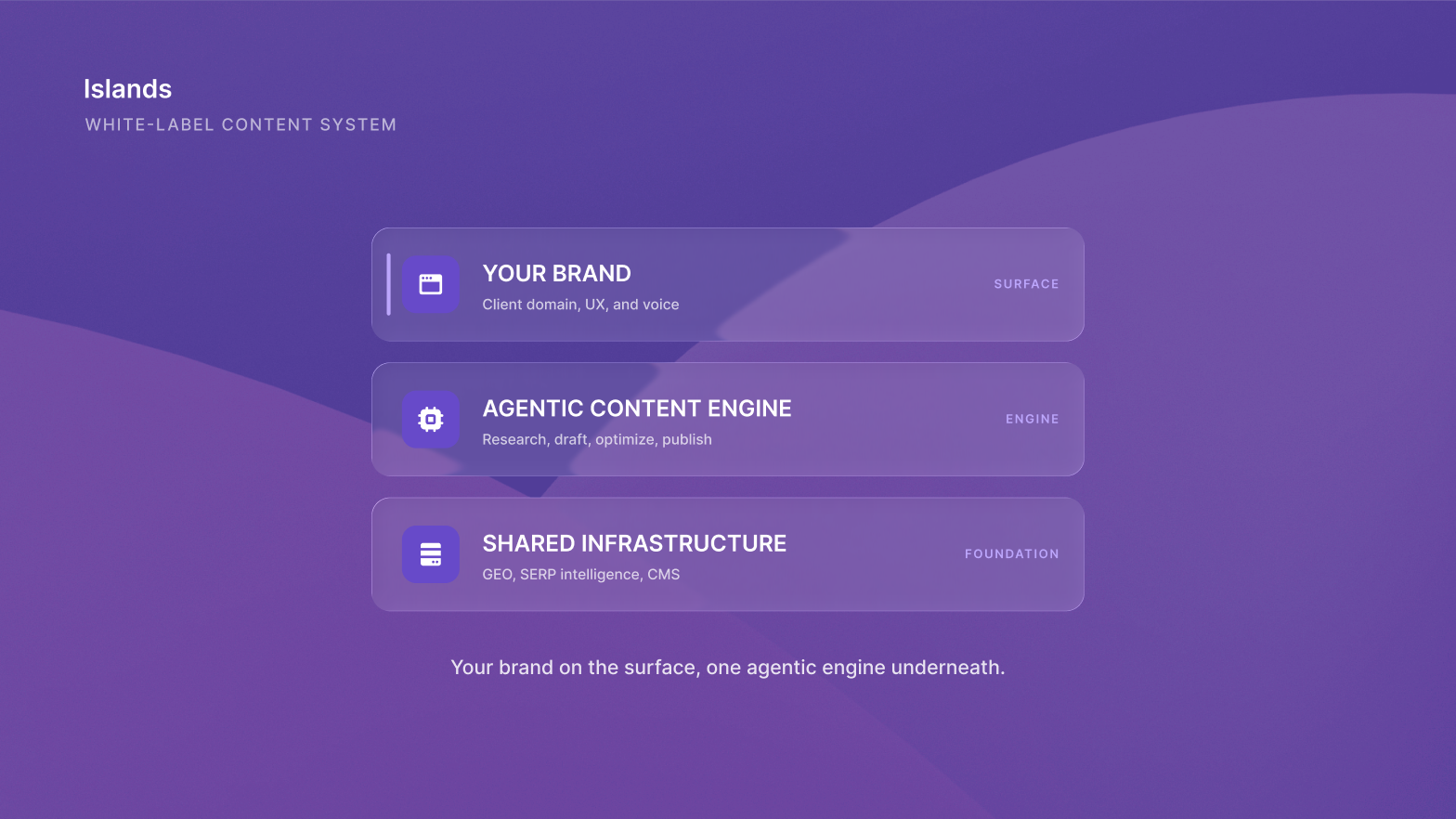
Thin wrappers can't compete on ranking intelligence. They generate text blind to what actually ranks in the current SERP. Without a specialized orchestration layer, these tools churn out poor content that demands heavy human rework to reach publishable quality. Founders evaluating partners should look for production-ready orchestration — not a simple prompt interface.
Single-shot prompts that look great in a demo fail to hold brand voice at volume. Systems that can't access real-time SERP data or internal knowledge bases suffer context fragmentation. And without clear research and quality-check paths, human review collapses. Those are the real failure modes.
Building for AI search visibility and GEO
AI content automation means using structured agentic pipelines to research, generate, and share citable content. It's a shift from text generation to content engineering. Systems built around data and reusable components turn high-quality production into a repeatable process, not a heroic push. As the search landscape evolves, this architecture becomes essential.
AI search is expected to drive 50-60% of all search journeys by 2026. Meanwhile, traditional search volume is projected to drop 25%. Startups must optimize for Generative Engine Optimization (GEO) to keep their technical moats visible when AI agents become the primary web navigators. Maintaining that visibility requires integrating fractional AI specialists to adapt to these generative answer engines. AI coaching for founders also helps align these technical shifts with long-term strategy.
The build vs. buy framework for content infrastructure

For Series B founders, the decision to build internally or buy a white-label system comes down to capital efficiency. Infrastructure for non-core functions should be treated as a commodity. An in-house AI content and SEO team can cost over $300,000 per year in salaries alone, before tool costs. Modern teams are adopting autonomous financial guidance and similar agentic systems to protect back-office margins. Choosing a dedicated SaaS SEO content service lets companies maintain high output without internal overhead.
Tenant-safe architecture
White-label systems need to prioritize security and branded UX. In multi-tenant environments, data stays isolated. A single metric layer keeps quality high across niches while client data remains separate. In the 2026 search era, technical authority and information density are the only ways to avoid algorithm penalties. Those needing custom integrations can opt for full-stack AI development to keep proprietary data secure in their own cloud.
Composable CMS delivery
A headless or hybrid CMS enables multi-tenant delivery. Content stays inside the platform's control plane. That cuts the need for fragile third-party plugins that break during automated updates.
In-house vs. white-label efficiency
Roadmap to integrated content engineering
Start by auditing current manual workflows to find where the 60% task tax is highest. Then implement a tenant-safe architecture with row-level security. Next, shift from prompt libraries to autonomous research and distribution pipelines. Finally, integrate a technical integrator approach to ensure workflows focus on ROI, not just production volume.
The bottom line
Moving to an automated content system is no longer optional. Founders must do this to survive the 25% drop in traditional search volume. By shifting from manual editing to a white-label agentic infrastructure, startups achieve zero marginal cost of replication. Treating content as an engineering problem lets them capture the 60% of search journeys moving to AI engines through scalable white-label systems. White-label AI content keeps the brand competitive in a shifting digital environment.

Ready to scale your production with Islands? Book a call today.
Success Stories