A Checklist for Canadian Tech Implementation Grants: Funding Your AI Transformation

key takeaways
- SR&ED just doubled: the enhanced credit limit went from $3M to $6M for CCPCs, up to ~$2.1M back a year.
- IRAP pays before you spend: up to 80% of technical salaries, 50% of subcontractors, non-repayable.
- RAII is the AI-adoption engine: $200M, now $700M after the Oct 2026 expansion.
- Eligibility = technical uncertainty, not buzzwords. And you can stack all three.
I reviewed a series B balance sheet last week. The founder had a working prototype but no plan to fund the production-grade infrastructure needed to scale. They were treating AI implementation as pure equity burn. In 2026, that's a trap. Too many technical leaders overlook the non-dilutive engine Canada built to subsidize the shift to autonomous systems. Moving from experimental models to agentic AI demands a new funding approach for your engineering roadmap.
IRAP and RAII are Canadian tech implementation grants. They are non-dilutive. Their purpose is to subsidize the adoption and commercialization of advanced technology. Unlike R&D tax credits that reimburse past spending, these grants provide direct contributions. IRAP covers up to 80% of eligible technical salaries and up to 50% of subcontractor costs. A share of your R&D labour, not your total project budget.
The funding hierarchy: SR&ED vs. IRAP for AI
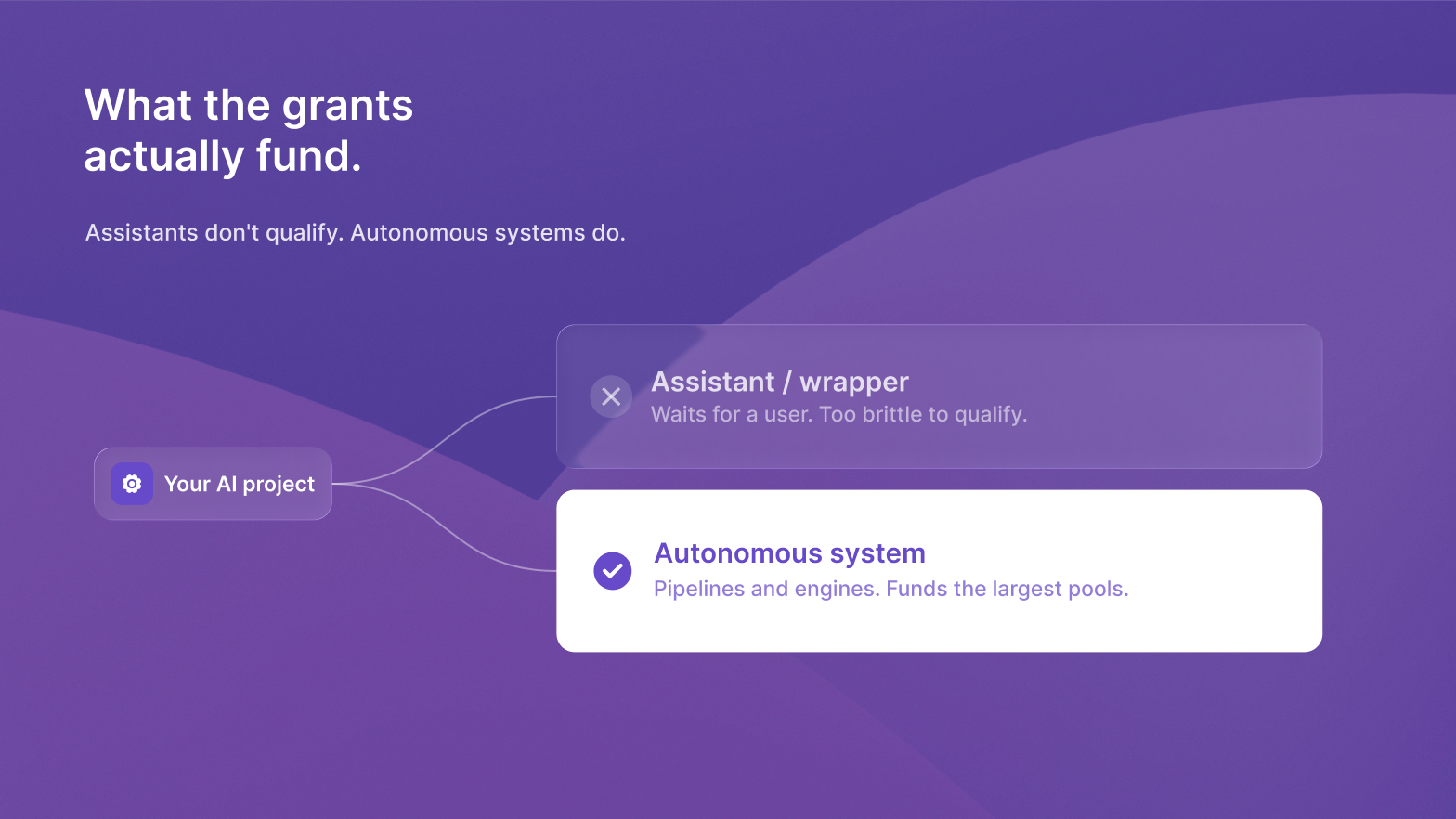
The 'assistant trap' catches most founders. They fund small experiments but never secure capital for full workflow replacement. SR&ED is a powerful innovation tool. It is fundamentally a tax incentive for research. In 2026, SR&ED expenditure limits increased to $6 million for Canadian-controlled private corporations. These credits only apply to work involving technical uncertainty.
IRAP serves a different purpose. It provides direct cash subsidies year-round for innovation projects. For a scale-up building a production-grade system, IRAP is often the better vehicle for scaling precisely because it focuses on adoption and commercialization rather than just the underlying research. Technical leaders use these funds to lower the real cost of building senior engineering teams in Canada.
SR&ED and IRAP eligibility for AI projects
Regional artificial intelligence initiative: your implementation engine
RAII launched in 2024 as a $200 million national effort and was expanded in October 2026 by a further $500 million, $700 million total delivered through regional development agencies to support AI adoption. The program is built for businesses ready to move past model development and into full-scale integration. Intake runs on a rolling basis through each regional agency until funding is committed — confirm the current window for your region before applying.
For SMEs, RAII provides interest-free repayable contributions, typically $250K–$5M per project, toward AI commercialization and adoption. This is the engine for scaling AI infrastructure without equity dilution. By using these regional agencies, technical leaders can offset high costs for specialized compute and senior talent required to deploy autonomous systems across their operations. Founders should treat these non-dilutive funding strategies as a core part of their capital stack.
A checklist for Canadian tech implementation grants
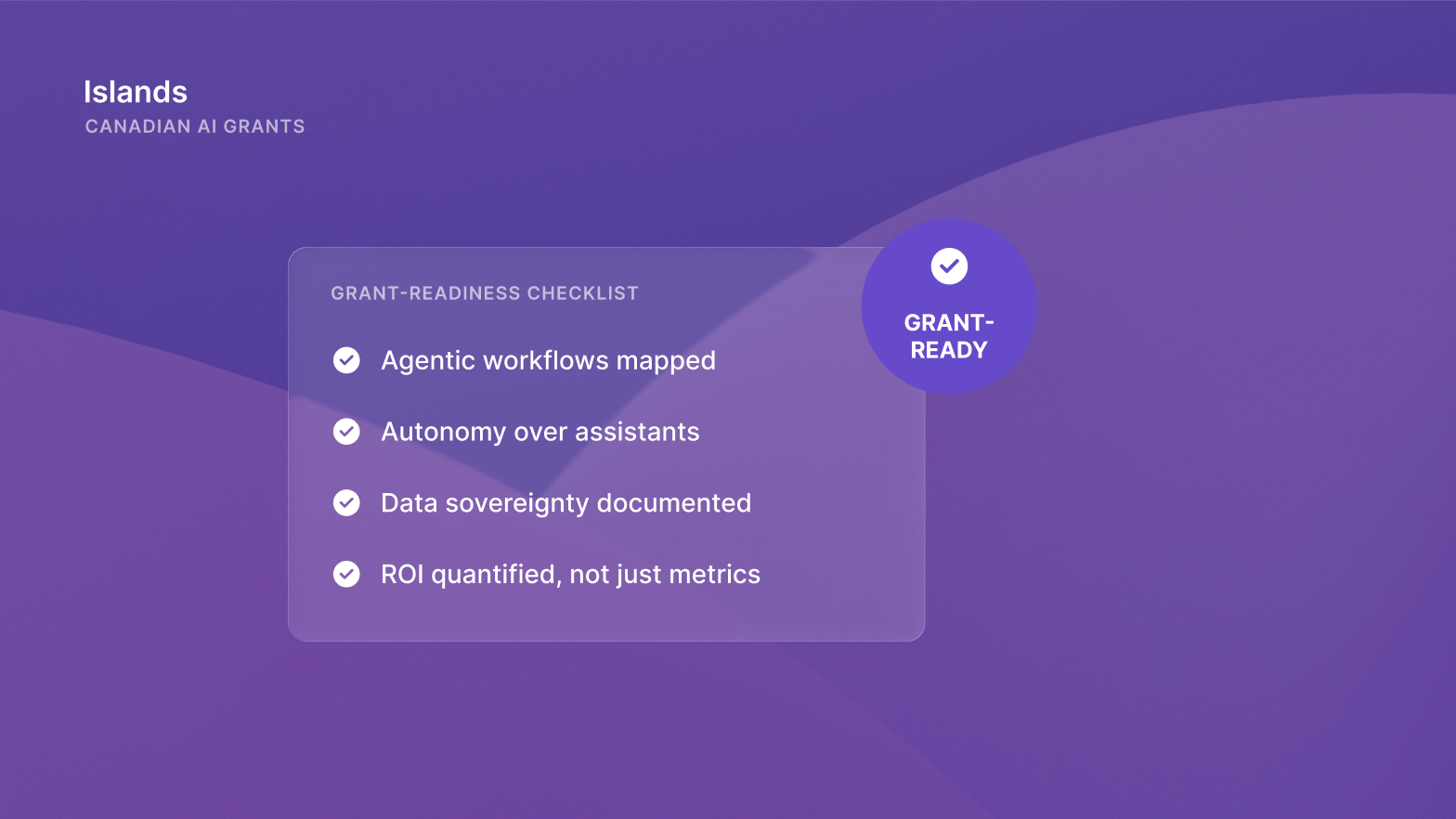
To secure these funds, you need rigorous documentation of your agentic AI systems and their impact on your business unit economics. Use this checklist to prepare your application:
- Define the technical scope: Distinguish between model development (R&D) and integration of existing solutions into your operations.
- Establish acceptance criteria: Specify measurable business changes and performance metrics the AI system must achieve.
- Map the workflow: Create a step-by-step roadmap for how autonomous agents replace or enhance existing manual processes.
- Audit financial readiness: Ensure you have internal capital to cover the remaining 20% to 25% of costs not covered by the grant.
- Verify data quality: Demonstrate that your internal data rights and quality support the proposed AI validation plan.
Calculating the ROI of subsidized automation
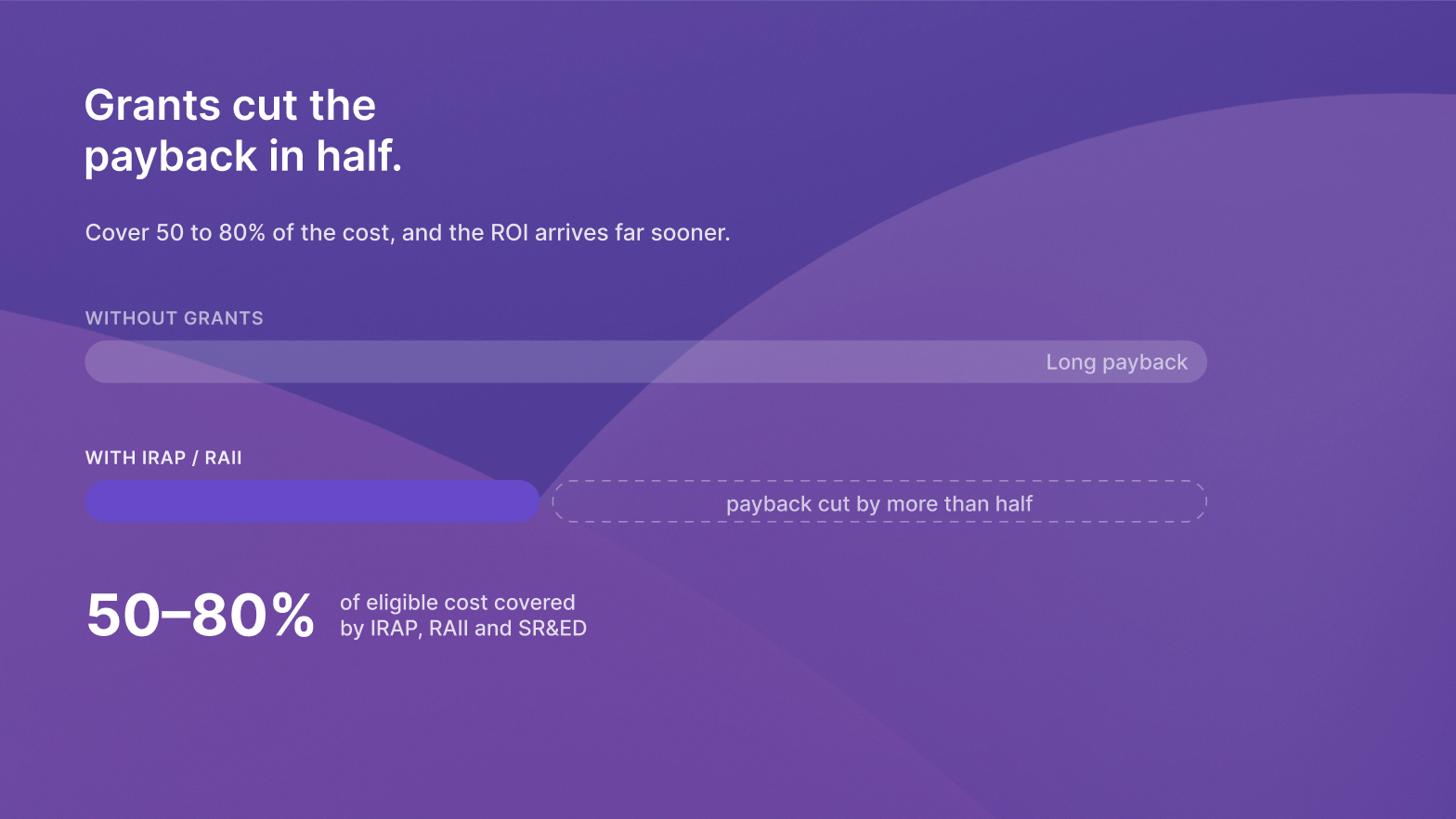
When you categorize engineering work as refundable R&D and layer it with implementation grants, the unit economics of AI transformation shift drastically. The goal is to move from manual prompting to programmatic pipelines. In manual workflows, the 'edit tax' often kills ROI because humans must verify every output. Production-grade systems solve this by building automated verification layers directly into the architecture.
Using government capital to fund these pipelines offsets a large share of the build cost — without giving up equity. You can scale operations without a linear increase in headcount. The shift to autonomous systems is no longer a research experiment. It is a strategic infrastructure play that determines market dominance. Success often requires specialized R&D tax credit consultants who understand technical uncertainties like LLM fine-tuning.
What to do next
- Audit current R&D spend: Find which parts of your engineering burn qualify for the 2026 SR&ED expansion.
- Identify implementation targets: Find the manual bottlenecks in your workflow ready for agentic replacement, such as E-commerce AI solutions.
- Engage a technical consultant: Find a partner who can translate your technical architecture into a narrative that meets federal innovation standards.
- Apply for RAII or IRAP: Start the intake process early to secure non-dilutive AI infrastructure funding before the 2028 funding window closes.
The bottom line
Moving from experimentation to autonomous systems requires more than code. It requires a capital strategy that uses every available lever. Government grants are the non-dilutive engine that will power the next generation of Canadian AI leaders.
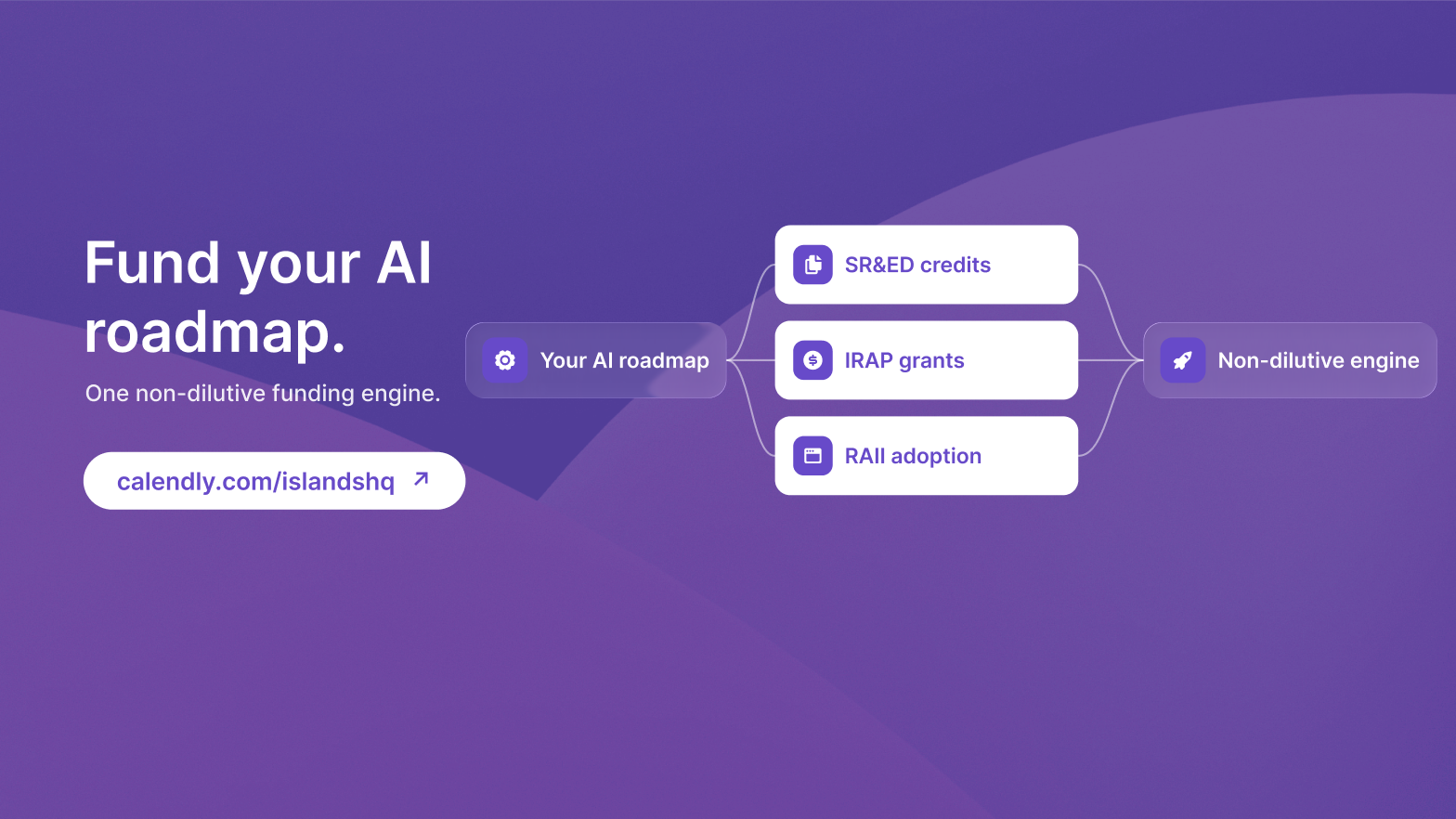
Schedule a technical deep dive to optimize your infrastructure and eliminate operational bottlenecks today.
Success Stories