.svg)
How to Get the Ontario AI Training Grant: Upskilling Your Team for Agentic Workflows

- For most companies, the Canada-Ontario Job Grant (COJG) is the one to use: up to $10,000 per employee, with small businesses (under 100 staff) recovering up to 83% of training costs. OCI's Future Ready is narrower — 50% up to $10,000 per company, and only for Manufacturing, Construction, Agri-food, or Mining.
- The funding only pays off when the training targets production-grade agentic work — autonomous decision logic, API execution, QA agents — not basic AI literacy.
- Timing and documentation decide it: tie training to Ontario growth, secure approval before it begins, and confirm the program is open before you commit.
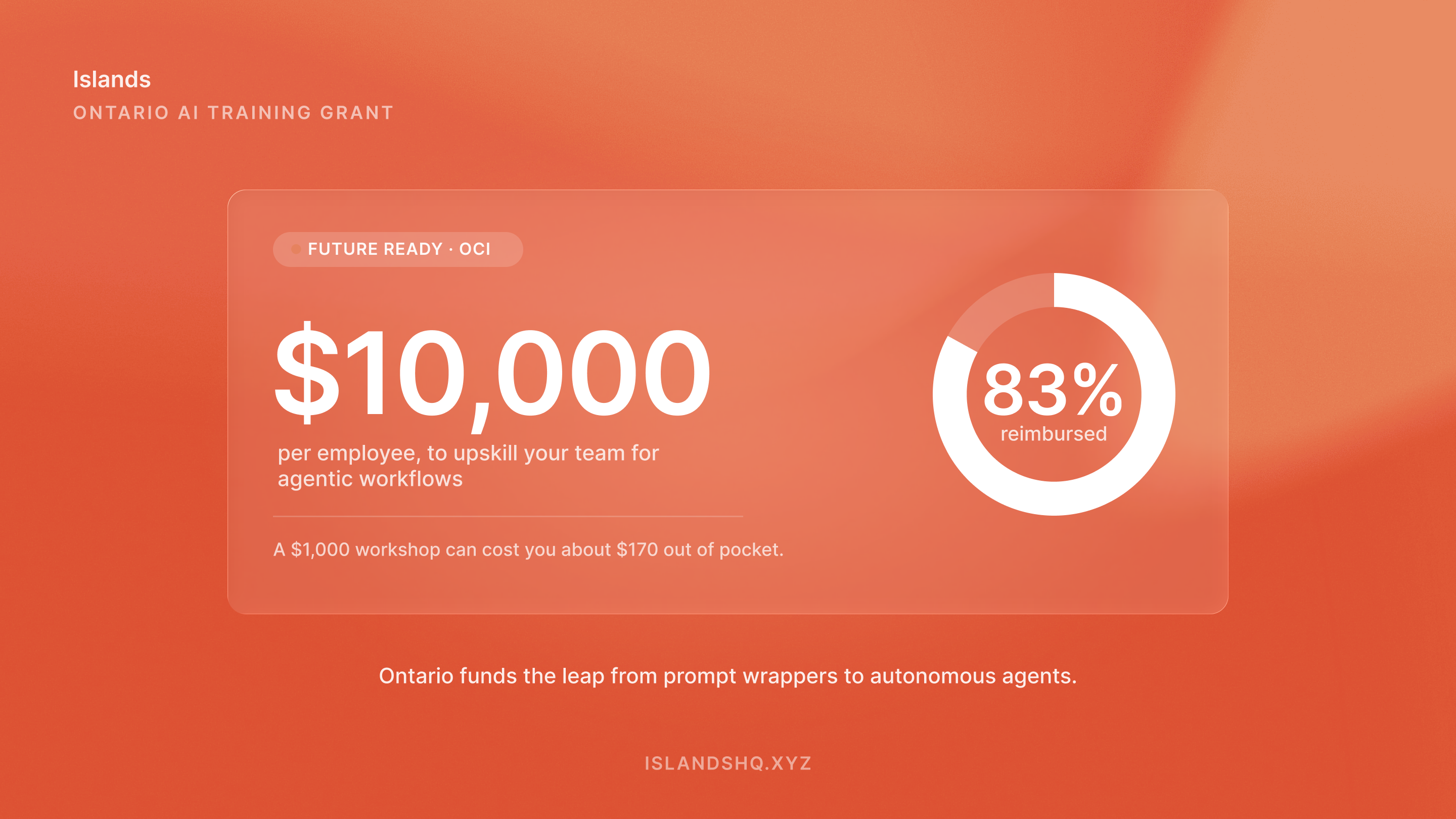
I recently spoke with a Toronto-based CTO who was burning capital on manual QA cycles while ignoring a $10,000-per-head subsidy available to provincial businesses. Failing to use provincial funding for AI transformation is a failure of architectural strategy. Securing an Ontario training grant is an effective way to offset the costs of technical evolution. Many engineering leaders focus on basic LLM wrappers that require constant human hand-holding. The real shift involves moving toward autonomous agentic systems that execute workflows independently.
Ontario's grant ecosystem is designed to fund this specific leap. Building moats through task-specialized AI architecture reduces reliance on linear headcount growth. To scale these systems without equity dilution, leaders should use Canadian tech implementation grants as a core capital strategy to bridge the gap between R&D and sustainable production.
Maximizing Ontario's AI training grants for SMEs
The Ontario AI funding landscape: OCI and training subsidies
The Future Ready program
Ontario also runs a more specialized option. The Ontario Centre of Innovation (OCI) manages the Future Ready program, which reimburses 50% of eligible training costs up to $10,000 per company (not per employee), with the business matching the other half 1:1. The catch: Future Ready is open only to SMEs operating in Advanced Manufacturing, Construction, Agri-food, or Mining. If your company sits outside those sectors — most SaaS and services firms do — COJG is the grant to pursue. Technical leaders who know that general AI literacy is no longer a competitive advantage should pay attention. The funding makes possible the transition toward a hybrid marketing and operations model that uses fractional specialists to optimize for generative answer engines.
Examples include the Agentic AI courses delivered by regional partners. These focus on the transition from passive chat interfaces to active, goal-oriented orchestration. For Ontario founders, paying full price for engineering upskilling effectively subsidizes competitors who are taking these programs.
Reimbursement tiers for SMEs
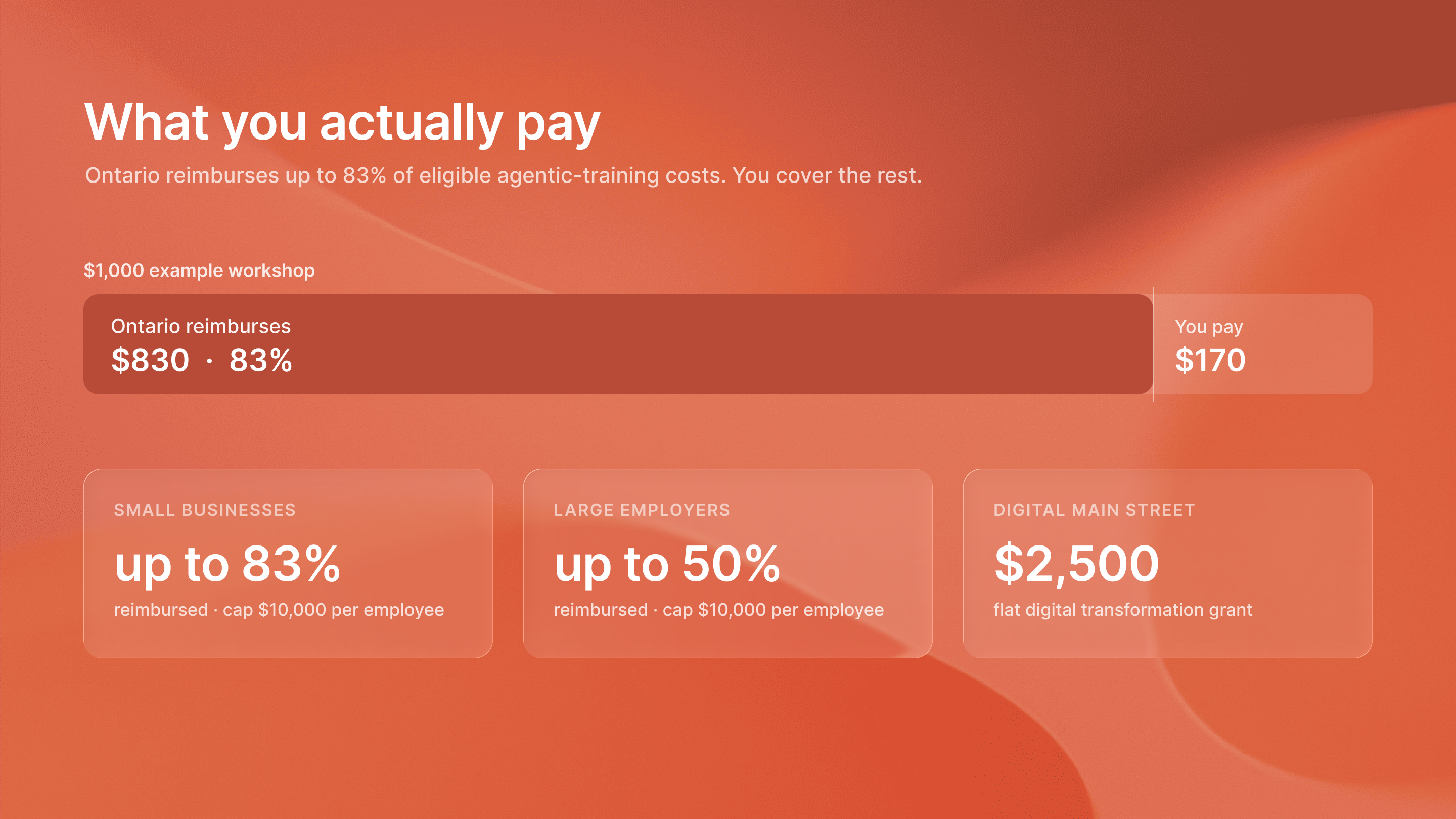
For small employers in Ontario, the financial incentive is aggressive. Under the Canada-Ontario Job Grant, small businesses (fewer than 100 employees) qualify for up to 83% reimbursement of eligible training costs, capped at $10,000 per employee. A high-impact workshop that costs $1,000 could effectively cost the employer about $170 out-of-pocket. Employers with 100 or more staff receive 50% reimbursement.
Series B startups can move beyond one-time workshops and instead embed engineering pods into continuous learning journeys that integrate real-time performance data with AI-powered coaching. Startups can further optimize their burn rate by using Canadian technical hubs to achieve cost advantages.
Ontario AI training grant reimbursement comparison
Qualifying for agentic workflow training
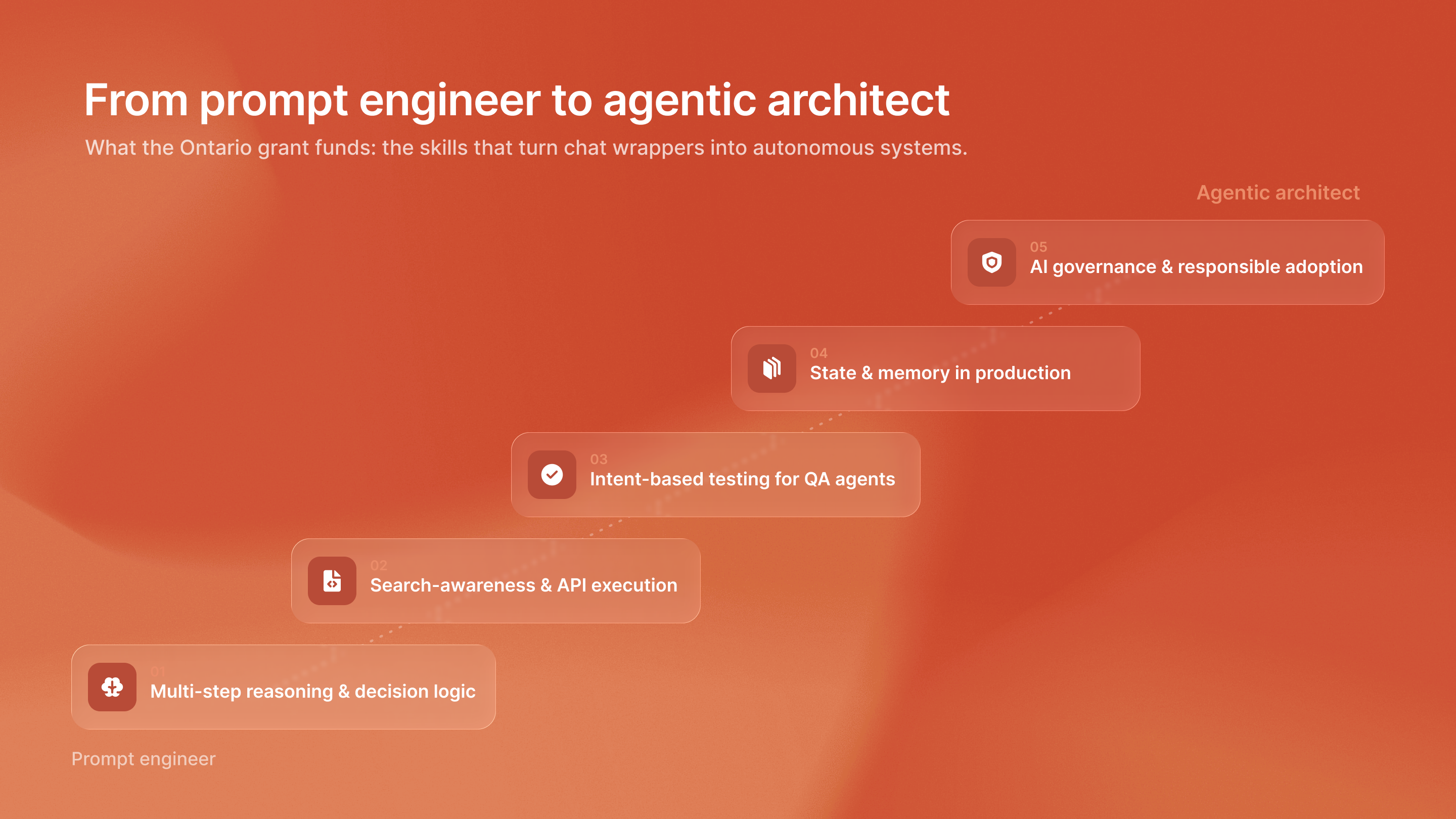
The gap between a prompt engineer and an agentic architect is wide. These grants bridge this gap by funding training that focuses on production-grade automation. A training plan must move beyond basic AI literacy and focus on the technical complexities of AI agent development.
Key qualifying activities for non-dilutive AI funding include:
- Designing multi-step reasoning chains and autonomous decision-making logic.
- Implementing search-awareness and independent API execution for agents.
- Developing intent-based testing frameworks for autonomous QA agents.
- Managing state and memory in production-grade AI systems.
- Establishing AI governance, security protocols, and responsible adoption frameworks.
Avoiding the application pitfalls
Documentation is where most applications fail. The province requires a clear link between the training and the economic impact on Ontario. Applications that describe projects as informal experimentation are often rejected. Documentation must frame the upskilling for agentic workflows as a direct contributor to productivity and export growth.
Founders must account for the fact that your grant application's first reader isn't human, requiring tactical adjustments to pass automated screening filters. Precise, technically sound documentation is necessary from the first submission. Timeline management is another hurdle;provincial funds often require approval before training begins, so managing these lead times is essential to guarantee reimbursement.
Beyond training grants, startups can further support their roadmap by using the Digital Main Street $2,500 Digital Transformation Grant to shift operations online (GrantWise Canada). Startups should also ensure their technical R&D is documented correctly to maximize SR&ED tax credits and avoid audit risks. Building the funding strategy into the technical roadmap before signing training contracts is the most effective approach.
Action plan: Securing your AI subsidy
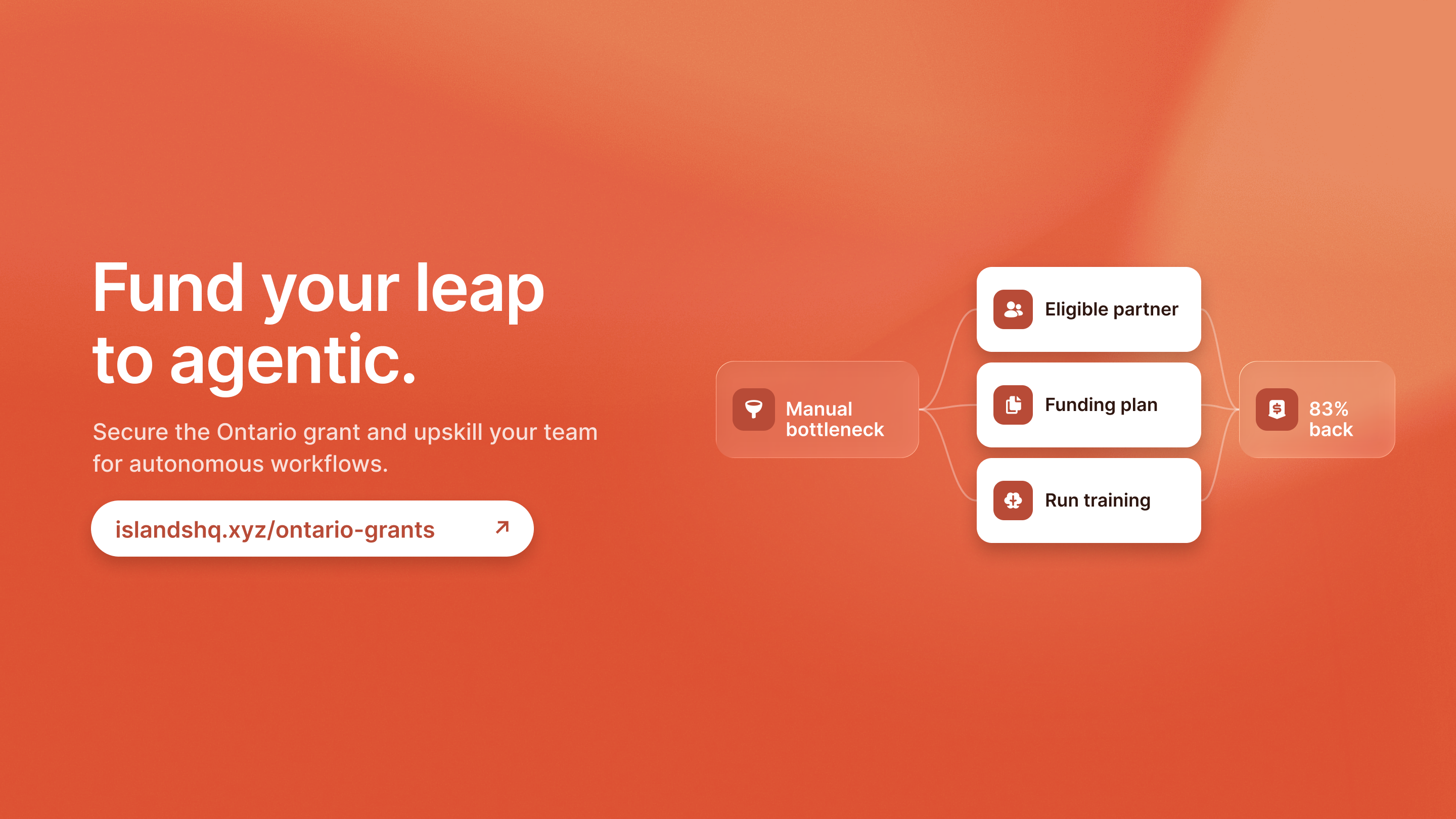
- Identify a high-impact operational bottleneck, such as manual data entry or repetitive QA cycles, that can be solved by an autonomous agent.
- Select an eligible third-party training partner that specializes in agentic orchestration rather than basic prompt engineering.
- Submit a digital transformation plan through the Ontario DMAP grant or OCI Future Ready portal to secure matching funds.
- Execute the training and submit final invoices for the 83% reimbursement once the program is complete.
The bottom line
The transition from manual cycles to autonomous systems is the way to scale without bloating the P&L. Regional support is available to offset these costs, but it requires architectural rigor and proactive planning. The cost of transition is subsidized today, but the window for these grants is limited.
Schedule a technical deep dive to optimize your infrastructure and eliminate operational bottlenecks today.
Success Stories
Read more

.svg)
