.svg)
How to Automate SEO Content with AI Pipelines: Beyond Simple Prompting

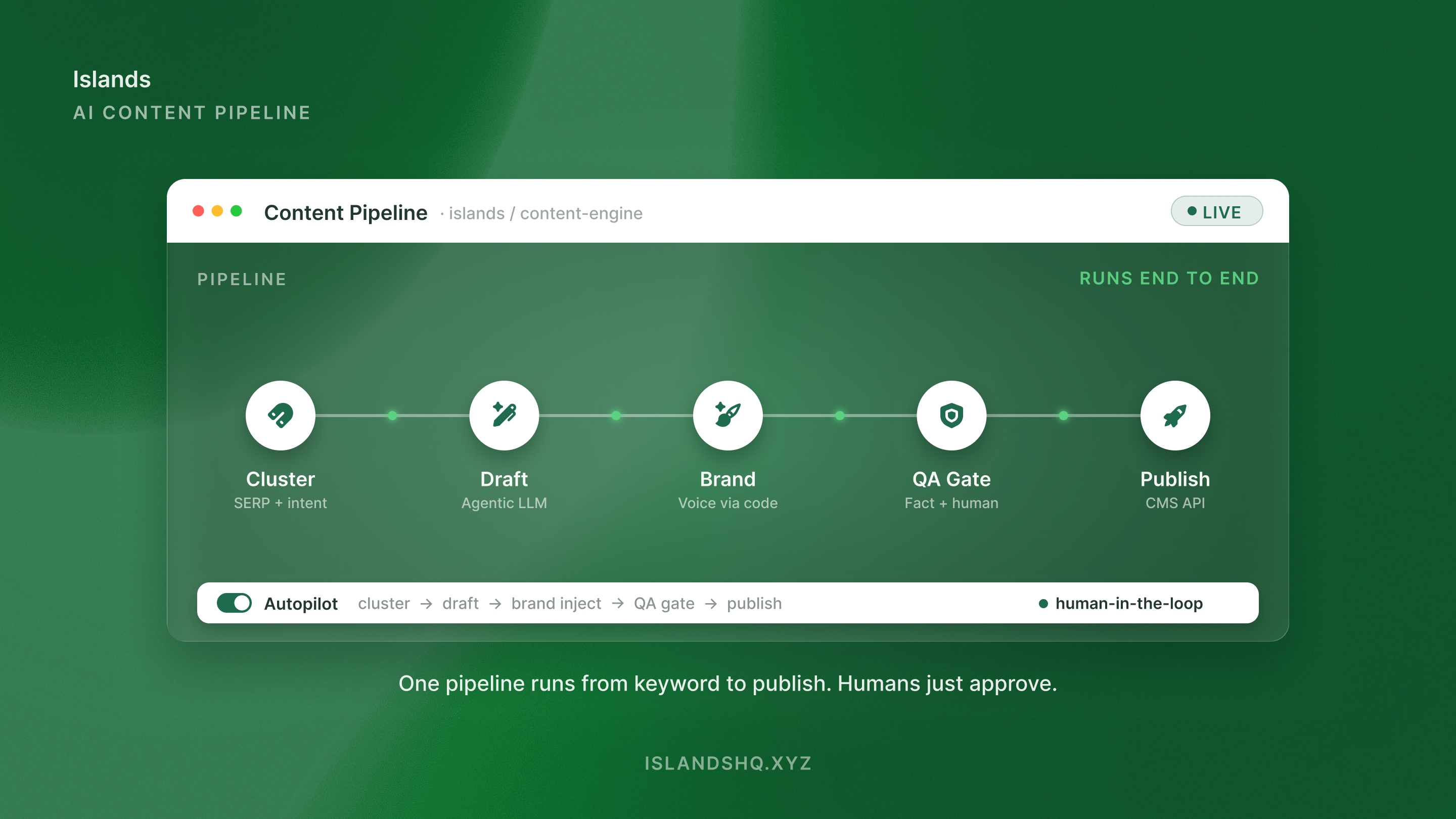
Last week, I reviewed a Series B roadmap where the SEO strategy was just a junior marketer with a ChatGPT Plus subscription. It was a scaling disaster waiting to happen. The founder was proud of their volume, but a quick audit revealed a mess of generic advice and inconsistent brand voice. That's the prompting ceiling — the point where manual work with a chatbot stops delivering and starts costing you more than it's worth.
Key Takeaways:
- Move from prompts to pipelines: Programmatic orchestration outscales manual prompting every time.
- Quality gates are non-negotiable: 78% of AI content requires significant editing before it is usable.
- Architecture defines ROI: Modular systems reduce redundancy by 47% and accelerate localization.
- Human-in-the-loop is mandatory: Automated pipelines must include expert checkpoints to avoid search penalties.
The Prompting Ceiling: Why Your Current Workflow Won't Scale
Most teams are stuck in an experimental loop. According to Gartner, only 23% of B2B marketing teams have moved past systematic AI workflows into production. The rest are still prompting, copying, and lightly editing. That loop breaks down fast. You cannot maintain quality at the volume a growing company demands.
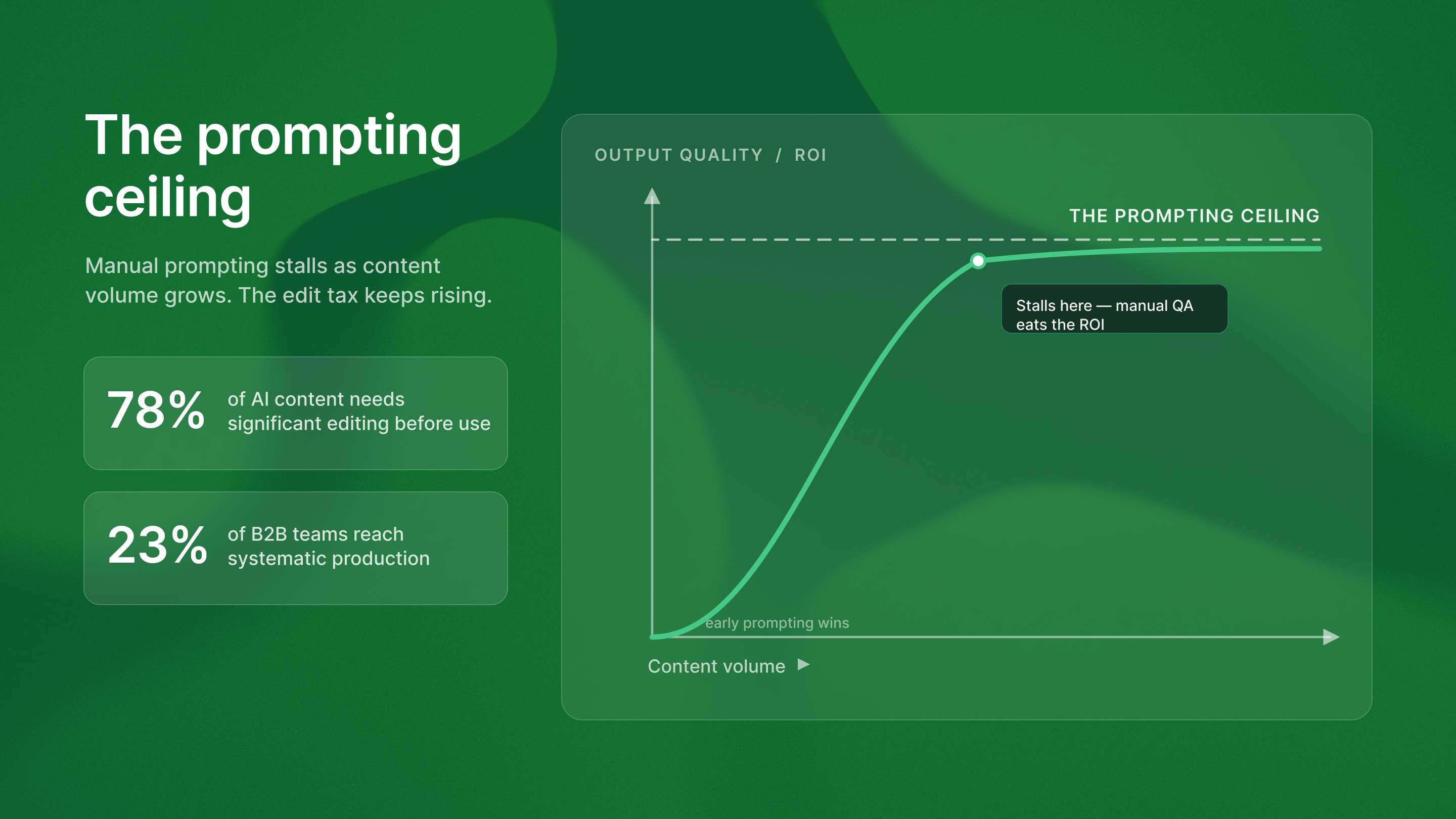
The 78% Edit Tax
Research from the Content Marketing Institute found that 78% of marketers say AI-generated material requires significant editing. Simple prompts shift the editing burden onto your people. You end up subsidizing a high-cost manual review queue instead of getting usable output straight out of the model.
Manual Bottlenecks in Production
Scaling a content engine is not about writing faster. It is about maintaining semantic relevance and brand alignment at scale. I have seen teams hit a wall when the cost of human QA eats up every dollar saved by AI generation. That failure happens when you rely on single prompts instead of a task-specialized AI architecture that distributes research and drafting across multiple stages. Without that shift, you are not automating. You are just moving the bottleneck.
Architecting the Autonomous Content Pipeline
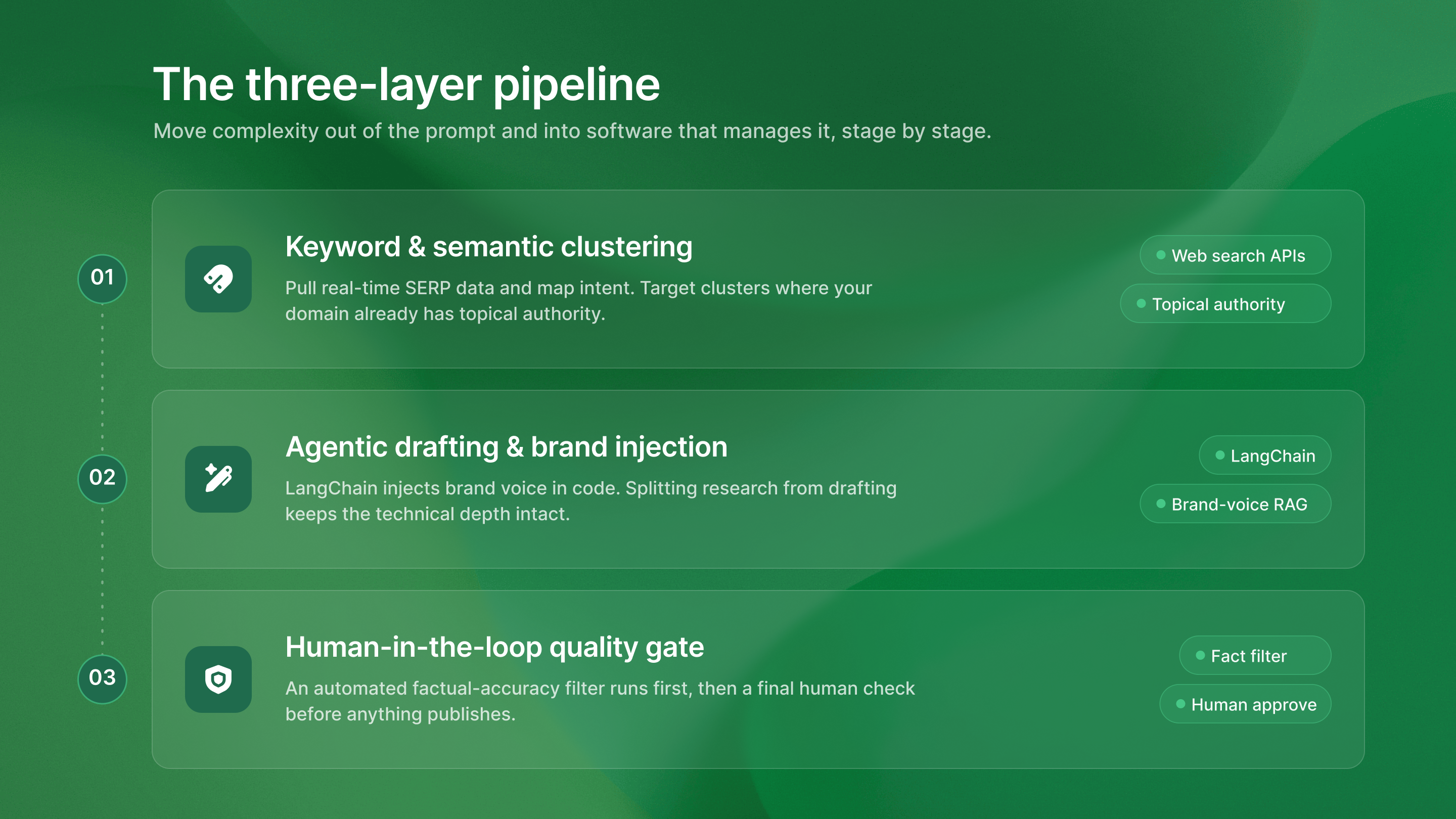
Breaking the ceiling means building Agentic AI systems. Treat content as an engineering problem, not a creative one. That means a three-layer pipeline.
- Layer 1: Keyword and Semantic Clustering. Use web search APIs to pull real-time SERP data instead of doing manual research. The goal is to find clusters where your domain already has strong topical authority.
- Layer 2: Agentic Drafting and Brand Injection. Frameworks like LangChain let you inject brand voice programmatically. Multi-stage agentic pipelines separate research from drafting, which keeps technical depth intact.
- Layer 3: The Human-in-the-Loop Quality Gate. Every piece goes through an automated factual-accuracy filter first, then a final human check. That is how you build content that sounds human while keeping technical rigor.
Technical Requirements for Series B Scale
Building this infrastructure requires a tech stack that moves beyond the LLM wrapper. You need a system that manages state and metadata across the entire lifecycle.
- Orchestration Layers: LangChain or similar scripts manage complex, multi-turn agent interactions.
- Metadata Schemas: Structured content architecture makes localization faster and cuts content redundancy.
- CMS API Integrations: Direct programmatic publishing removes manual copy-paste steps.
- Semantic Memory: A vector database can support retrieval of previously published content, terminology, and brand guidance so the generation pipeline can use that context.
Roadmap: Moving to Agentic AI Systems
- Audit your current stack: Find where manual prompting creates a backlog in your marketing workflow.
- Define your quality gates: Set programmatic standards for brand voice and factual accuracy.
- Pilot a modular pipeline: Start with one content cluster and build a specialized agentic workflow for it.
- Scale via API: Integrate the pipeline directly into your publishing tools to eliminate human touchpoints in distribution.
Growth-stage startups cannot win on volume alone. The market has moved, and simple prompting is now a commodity. Sustainable organic growth demands an engineering-heavy AI content automation strategy — one that prioritizes architectural reliability over raw text generation. The teams that build these pipelines today will own the search landscape tomorrow. Reach out to Islands for a technical audit of your AI infrastructure.

Success Stories


.svg)
