.svg)
From SaaS to agent-as-a-service: how to build AI agents for software platforms

A VP of Engineering at a Series B fintech recently showed me their new AI assistant. Within minutes, I realized it was just a glorified search bar. They didn't need a chatbot;they needed a digital employee. Many startups fall into the Series B scaling trap of building basic wrappers that fail to solve complex workflows. Transitioning to a proactive model is now a requirement for survival. The software must act on behalf of the user rather than just responding to manual inputs.
What we are seeing in the agentic market
The transition from SaaS to Agent-as-a-Service is not a UI update. It is an architectural overhaul. Teams that treat AI as a feature are seeing linear gains. Those building autonomous workflow systems are creating compounding assets. At Islands, we saw this change firsthand while launching production agents for QA flow, our autonomous testing platform. Understanding how to build AI agents for SaaS is now a critical skill for modern engineering teams.
Key results
- Shift from manual prompt-response loops to persistent autonomous workflows
- Higher ROI through the reduction of human-in-the-loop latency
- Increased platform stickiness as the software executes work while the user sleeps
- Transition from seat-based pricing to value-based outcome models
The architecture of autonomy: Beyond the chatbot
Moving from assistants to agents
Most current AI implementations are assistants. They require a human to provide a prompt, review the output, and take the next step. This is essentially just better plumbing for manual work. True autonomous agentic systems move the decision-making into the infrastructure itself. For engineering leaders, this means defining the next era of autonomy. Software will independently execute multi-step reasoning and tool integration.
The agentic loop vs. the command line
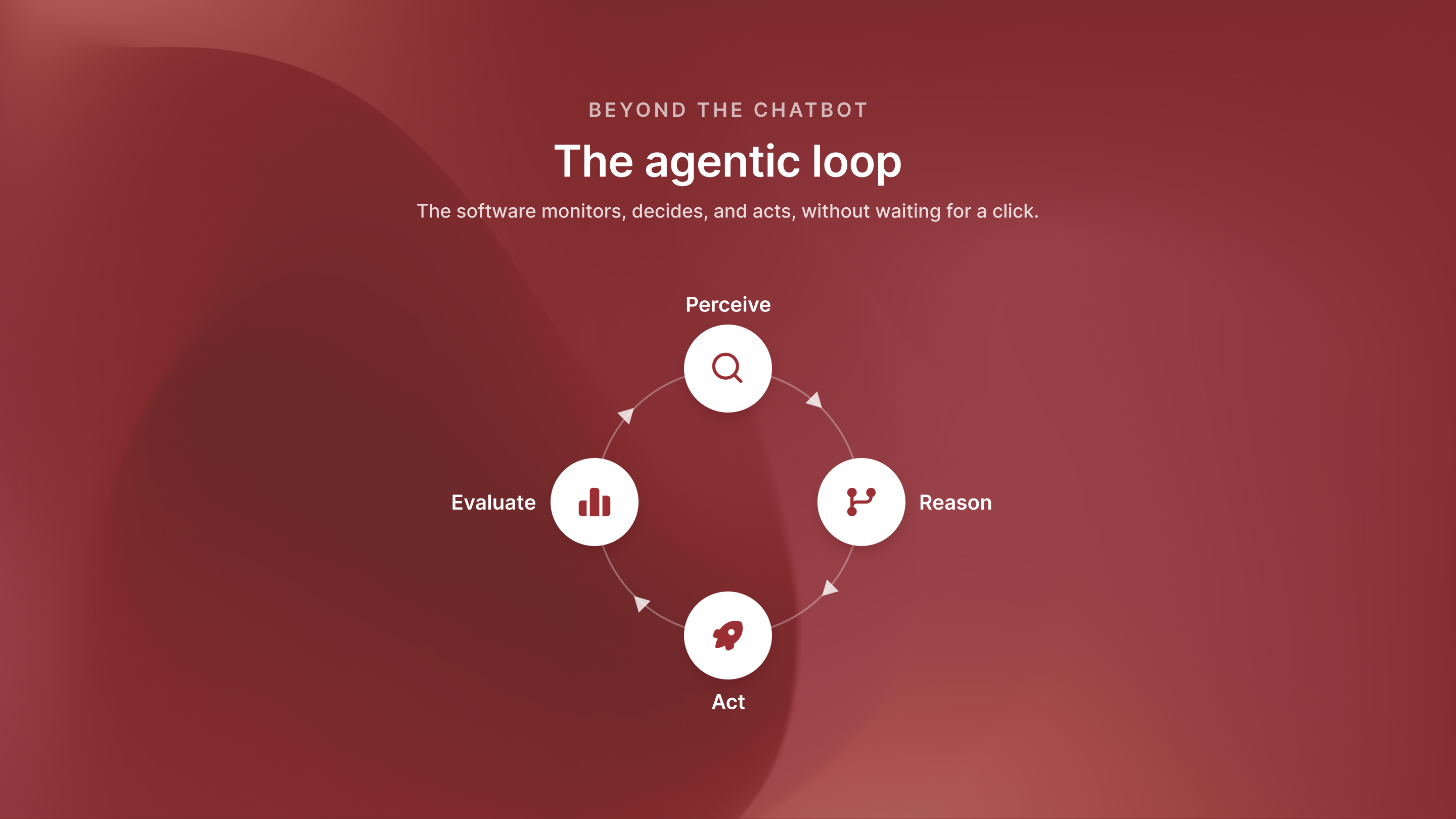
The agentic loop is a continuous cycle of perception, reasoning, and action. Unlike a command line that waits for a user, an agentic system monitors the environment. It executes workflows when specific conditions are met. This requires a robust task-specialized AI architecture that can manage state and handle errors without human intervention. Transitioning to an Agent-as-a-Service architecture means your software becomes a compounding asset.
Designing for agentic experience (AX)
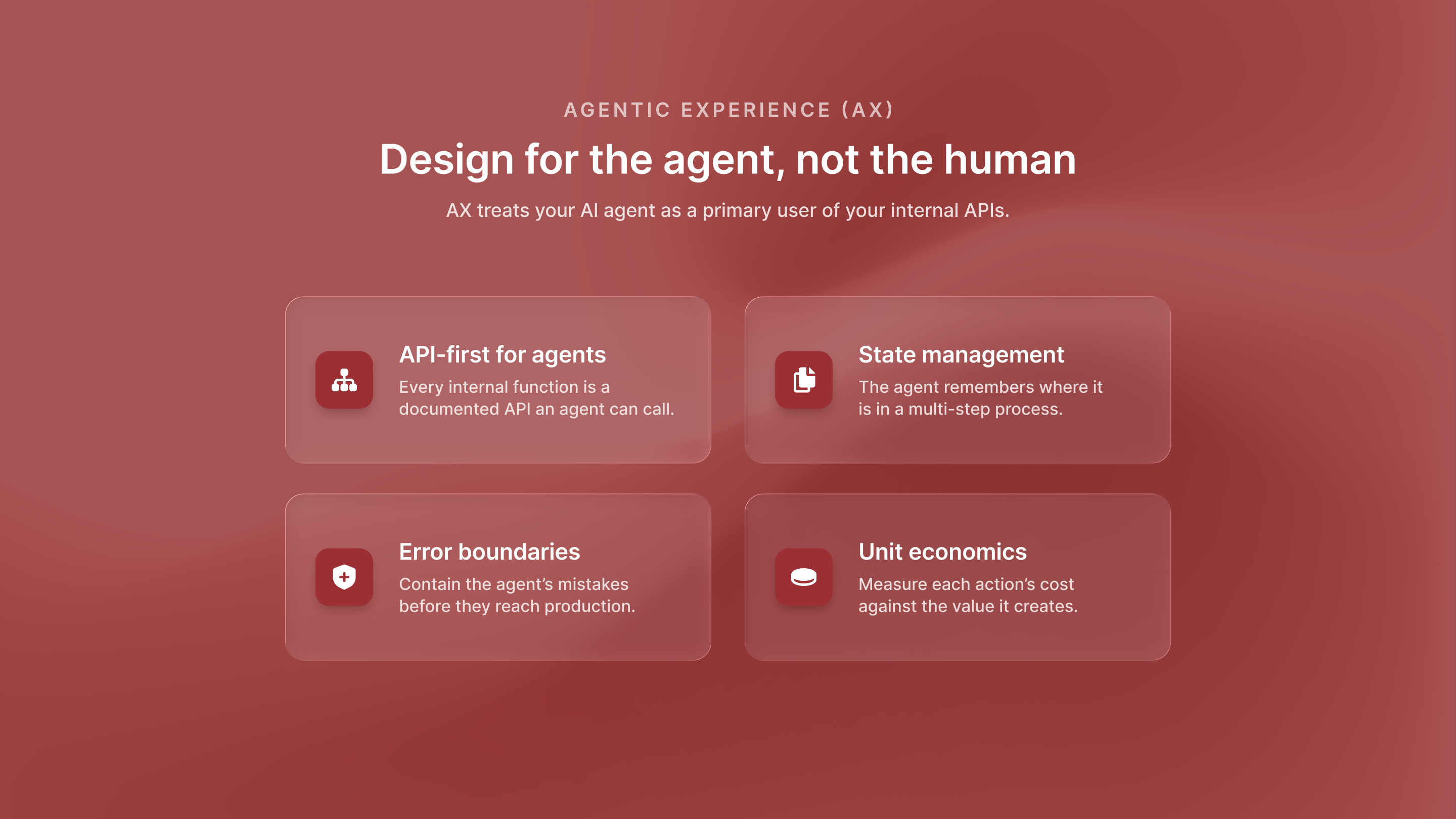
- AX focuses on the system's ability to execute complex tasks autonomously without constant hand-holding.
- It prioritizes transparency in the agent's decision-making process so humans can audit the reasoning.
- Agentic experience AX requires human-in-the-loop checkpoints for high-risk actions to maintain safety.
- It treats the AI agent as a main user of the software’s internal APIs, not a secondary add-on.
The implementation layer: Building for production
To build production-grade agents, you must expose your internal APIs to the agentic loop. This allows the agent to navigate the software just like a human user would, but at machine speed. Currently, only 16% of enterprise AI agents are actually autonomous. Most lack the planning and action layers required for real independence.
You are not just building a feature. You are building an environment where an agent can thrive. This involves managing latency, improving RAG pipelines, and ensuring each autonomous action has sound unit economics for your business. Many companies struggle with perception-only architecture that cannot be easily retrofitted for workflow replacement.
30-day roadmap to Agent-as-a-Service
- Identify a high-volume manual workflow that can be automated within your current UI.
- Audit your internal APIs to ensure they are accessible to an AI agent orchestration layer.
- Build an AI agent orchestration layer to manage the agent's state and multi-step logic.
- Implement an automated QA loop, like the one used in QA flow. Use it to monitor the agent’s performance in real time.
- Scale the agent to handle increasing volumes of autonomous work across the platform.
The bottom line
Static software is a legacy asset. The future is a dynamic workforce built directly into your platform. If you are still building assistants, you are creating a bottleneck. Start moving toward an Agent-as-a-Service architecture to unlock true autonomous value today. Reach out to Islands for an AI audit to identify where your architecture is holding you back. Book a call to get started.
Success Stories
Read more

.svg)
