.svg)
Enterprise AI strategy: complete framework for series B+ companies

Most enterprise AI strategies fail because they start with technology. We start with leverage points.
Here's the framework we use across our portfolio-and you can steal it.
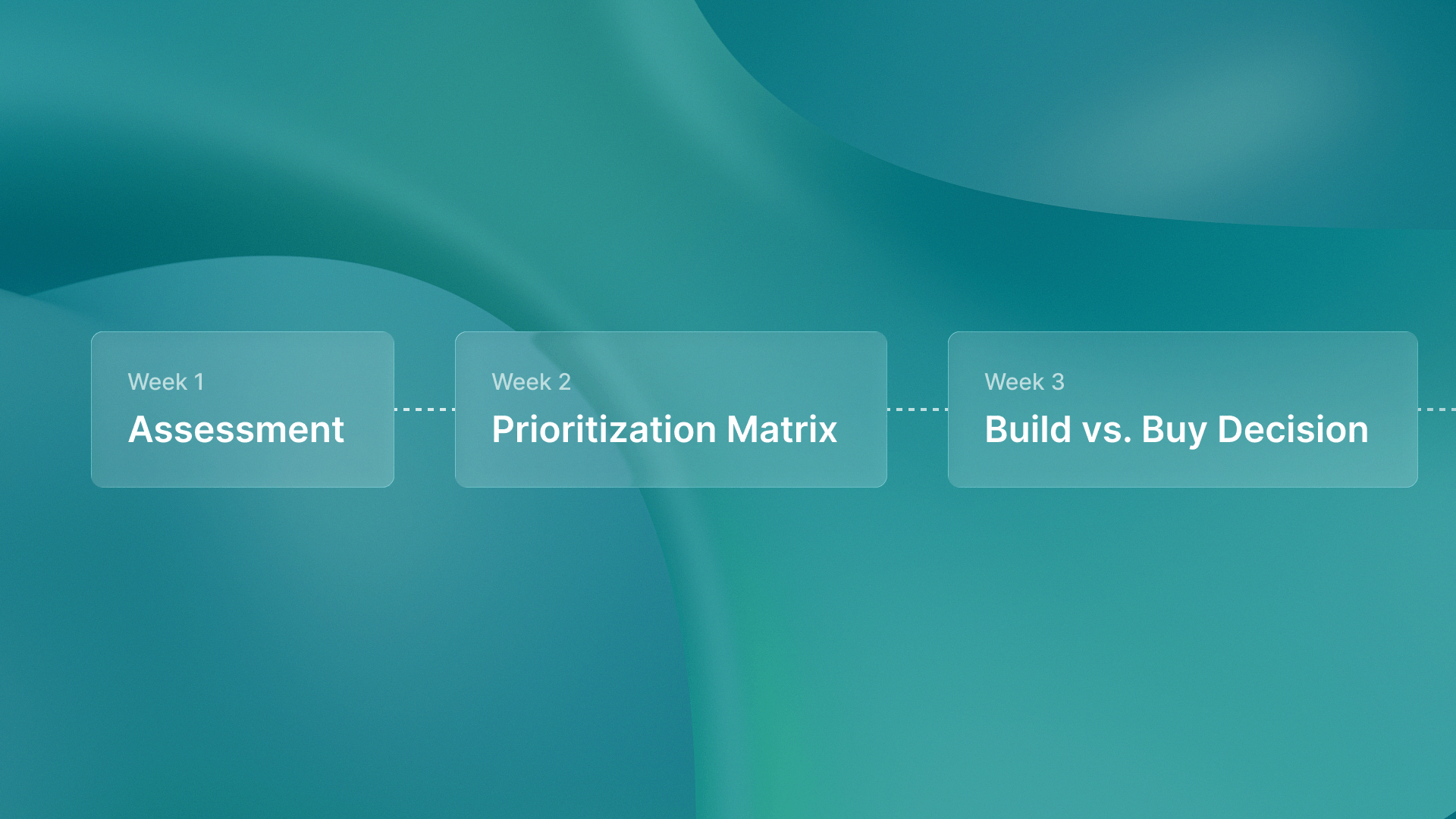
Week 1: Assessment
Before writing a single line of code, map your leverage points.
Step 1: Process mapping
Document your top 10 workflows:
- What happens?
- How long does it take?
- Who's involved?
- Where do bottlenecks occur?
Step 2: Cost analysis
For each workflow, calculate:
- Direct costs (salaries, tools)
- Indirect costs (time, opportunity cost)
- Error costs (bugs, compliance, support)
Step 3: Automation potential
Rate each workflow 1-10 on:
- Repetitiveness (how similar is each instance?)
- Volume (how often does it run?)
- Structured-ness (are rules clear?)
- Measurability (can you verify success?)
The formula: Automation score = (Repetitiveness + Volume + Structured + Measurable) / 4 Workflows scoring 7+ are prime candidates.
Week 2: Prioritization matrix
You can't transform everything at once. Here's how we prioritize:
Quadrant 1: Quick wins (START HERE)
- High automation score
- Low technical complexity
- High business impact
- Examples: QA testing, data validation
Quadrant 2: Strategic bets
- High automation score
- High technical complexity
- High business impact
- Examples: Customer onboarding, compliance
Quadrant 3: Nice-to-haves
- Low automation score
- Low technical complexity
- Medium business impact
- Examples: Content generation, email drafting
Quadrant 4: Avoid (for now)
- Any combination that doesn't fit above
- Examples: Strategic planning, crisis management
Week 3: Build vs buy decision
For each prioritized workflow, evaluate:
Build custom when:
- Workflow is core to your product
- Volume is very high (>10K/month)
- You need deep customization
- You have AI engineering resources
Buy platform when:
- Workflow is common (sales, support)
- Volume is moderate (<5K/month)
- Speed to market matters most
- You lack AI engineering talent
Hybrid approach:
- Start with platform for learning
- Build custom for scale
- Most successful companies do both
Months 1-6: Implementation roadmap
Month 1: Foundation
- Pick first workflow (from Quadrant 1)
- Build minimal viable agent
- Deploy to 10% of traffic
- Measure religiously
Month 2: Optimization
- Reduce costs (prompt engineering, caching)
- Improve accuracy (better prompts, fine-tuning)
- Increase coverage (20% → 50% of traffic)
- Track ROI weekly
Month 3: Scale
- Deploy to 100% of traffic
- Build monitoring dashboards
- Document learnings
- Start second workflow
Month 4: Expansion
- Second workflow from Quadrant 1
- Apply learnings from first workflow
- Should take half the time
- Begin planning Quadrant 2 initiatives
Month 5: Sophistication
- Start first Quadrant 2 workflow
- Begin multi-agent orchestration
- Invest in shared infrastructure
- Hire/train specialized AI team
Month 6: Consolidation
- Measure cumulative ROI
- Identify patterns and reusable components
- Plan next 6-month roadmap
- Scale what works, cut what doesn't
The team structure
Phase 1 (Months 1-3):
- 1-2 full-stack engineers (building)
- 1 product manager (prioritizing)
- Subject matter experts (domain knowledge)
Phase 2 (Months 4-6):
- Add: 1 ML engineer (optimization)
- Add: 1 data engineer (infrastructure)
- Keep: PM and SMEs
Phase 3 (Months 7-12):
- Dedicated AI engineering team (3-5 people)
- Shared services for all AI initiatives
- Center of excellence model
The technology stack
Must-haves:
- LLM provider (OpenAI, Anthropic, or both)
- Orchestration layer (Temporal, Inngest)
- Vector database (Pinecone, Weaviate)
- Monitoring (Datadog, custom dashboards)
Nice-to-haves:
- Agent framework (LangChain, CrewAI)
- Fine-tuning infrastructure
- Prompt management system
Avoid:
- Over-engineering infrastructure
- Building what you can buy
- Lock-in to single vendor
The measurement framework
Track these metrics from day one:
Business metrics:
- Cost savings ($ per month)
- Time savings (hours per week)
- Quality improvements (error reduction %)
- Speed improvements (cycle time reduction)
Technical metrics:
- Task success rate (target: >90%)
- Average latency (target: <5 seconds)
- Cost per task (optimize monthly)
- Confidence scores (track distribution)
Strategic metrics:
- Team velocity (features shipped)
- Customer satisfaction (NPS impact)
- Competitive advantage (time-to-market)
The governance model
AI transformation needs guardrails:
Decision rights:
- Product team: What workflows to automate
- Engineering team: How to build it
- Leadership team: Budget allocation and priorities
- Compliance/Legal: Approval for sensitive workflows
Review cadence:
- Weekly: Tactical progress and blockers
- Monthly: Strategic direction and ROI
- Quarterly: Portfolio review and reallocation
Risk management:
- High-stakes decisions require human approval
- Gradual rollout (10% → 50% → 100%)
- Circuit breakers for runaway agents
- Regular audits of agent decisions
Common pitfalls
1. Analysis paralysis: Don't spend 6 months planning. Build something in month one.
2. Feature factory: Don't build 10 mediocre agents. Build 2-3 excellent ones.
3. Ignoring operations: Agents need monitoring, maintenance, and optimization.
4. Underestimating change management: Your team needs to learn new workflows. Budget time for this.
The success pattern
Across 40+ transformations, the winners:
1. Started with one high-impact workflow
2. Measured religiously from day one
3. Optimized costs in month two
4. Scaled proven patterns to new workflows
5. Built shared infrastructure by month six
They didn't try to transform overnight. They compounded small wins.
Your next step
If you're leading AI transformation at a Series B+ company:
This week: Map your top 10 workflows and score them
Next week: Pick one Quadrant 1 workflow to start
Month one: Build and deploy minimal viable agent
Month three: Measure ROI and decide: scale or pivot
The companies moving fastest aren't waiting for perfect strategy. They're building, measuring, and learning. That's the playbook.
Need help with your AI strategy? Islands offers strategy workshops for Series B+ companies. Visit islandshq.xyz/contact
Success Stories
Read more

.png)
.svg)
