.svg)
AI content agency vs traditional content agency: which actually ships more in 2026?


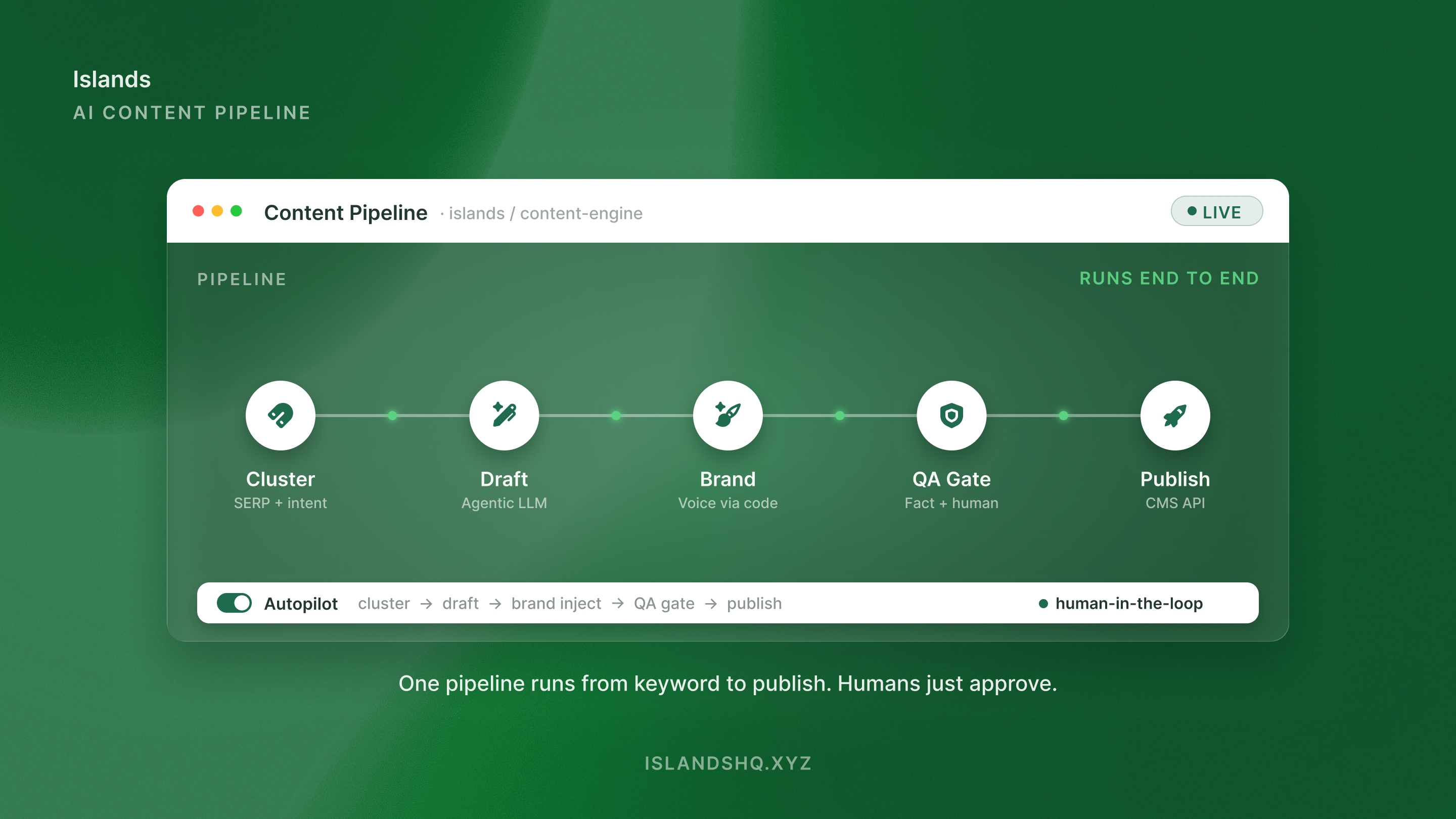
I recently watched a CMO struggle to justify a $40,000 monthly retainer for a legacy provider. They were delivering exactly four whitepapers a month. It was a clear headcount trap. In 2026, the gap between shipping and waiting is defined by your agency's tech stack. The AI content agency model has broken the old delivery ceiling. In a head-to-head, the difference in weekly output is no longer marginal. It's categorical.
The production equation
A AI content agency operates differently than a traditional content agency at every layer. Staffing, tooling, and measurement are all restructured around output velocity.
- Output rate. AI-native agencies average 15 to 40 assets per week for B2B clients. Traditional agencies typically produce 1 to 4 assets per week.
- Revision speed. Edits that once took 3 days now take 3 hours at AI-native shops.
- Format diversity. AI-native agencies produce in parallel across 8 to 12 content formats. Traditional agencies often specialize in 2 to 4 formats.
The unit economics of a b2b content marketing agency have shifted permanently. AI-driven firms report up to 60% higher margins. They do not carry the massive overhead of labor-heavy competitors. For the high-volume growth stage company, this is not a preference. It's a requirement.

Where the gap becomes critical
The unit economics of a b2b content marketing agency have shifted permanently. AI-driven firms report up to 60% higher margins. They do not carry the massive overhead of labor-heavy competitors. For the high-volume growth stage company, this is not a preference. It's a requirement.

GEO and SEO integration
AI-native agencies use real-time SEO adjustments during the generation process. This ensures every piece of content is optimized for generative discoverability before it even hits an editor's desk. Traditional agencies treat SEO as a post-production step. This creates a structural lag that no amount of editing can fix.

The bottom line
For founders and CMOs evaluating their content infrastructure, the decision is increasingly about system design, not creative quality. An AI content agency is not a replacement for human judgment. It's a system that removes the production ceiling entirely. Traditional agencies will remain relevant for highly specialized, low-volume engagements. For everything else, the AI-native model ships more. Full stop.
Success Stories

.svg)
