.svg)
The 5-agent content stack running Islands, QA flow, ReachSocial, and Shoreline

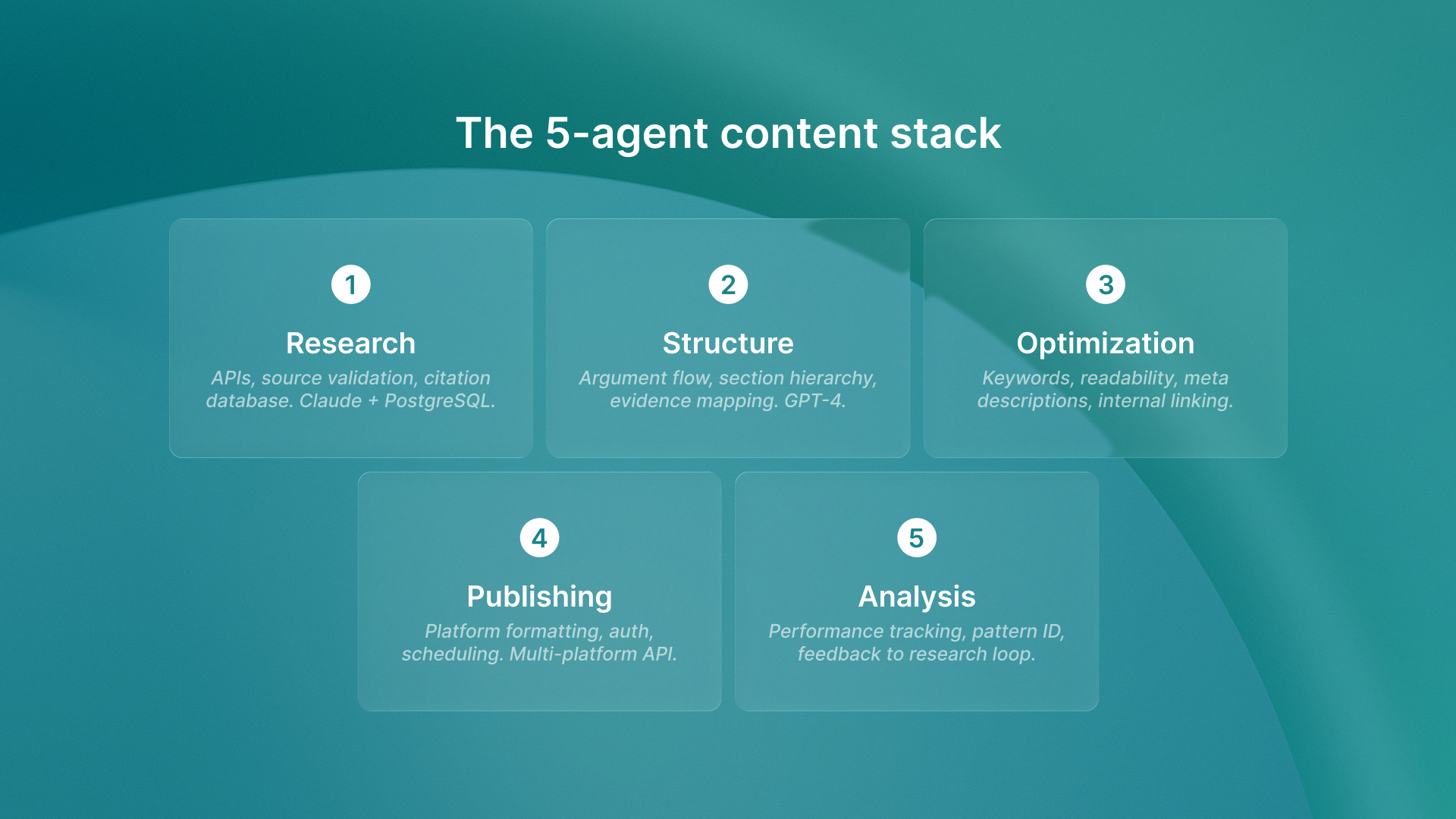
I've been watching the same pattern repeat across four production deployments. Multi-agent content systems look identical in demos but diverge completely at week 6 of production runtime.
Islands grew from 6 to 1,266 newsletter subscribers in 180 days using a 5-agent architecture. The same multi-agent content system runs content for QA flow, ReachSocial, and Shoreline. Multi-agent workflows saw 327% platform growth from 2024 to 2025 (Techzine Global). Gartner reported a 1,445% surge in multi-agent system inquiries from Q1 2024 to Q2 2025 (Techzine Global). Yet most implementations fail at orchestration, not agent capabilities.

The architecture mirrors software pipelines, not content workflows
Organizations report 45% higher organic traffic and 3x faster content creation with AI content automation. This approach uses specialist agents (Kodexo Labs). The multi-agent content system treats content like code. It uses discrete build stages, automated quality gates, continuous deployment, and performance monitoring.
Here's the 5-agent breakdown for the autonomous content workflow:
- Research agent: Aggregates sources, extracts data points, validates citations
- Structure agent: Generates content briefs with angle, key points, SEO elements
- Writer agent: Executes briefs into publication-ready drafts
- Optimization agent: Refines for search visibility and readability
- Performance agent: Tracks engagement, traffic, conversions
Each agent is a specialist. The research agent doesn't write. The writer agent doesn't optimize. The performance agent doesn't generate briefs. Specialization eliminates context bleeding and debugging nightmares that kill single-model systems. We covered the architectural reasons for this specialization extensively when examining why monolithic AI systems replicate 2010-era software failures.
The orchestration problem nobody talks about
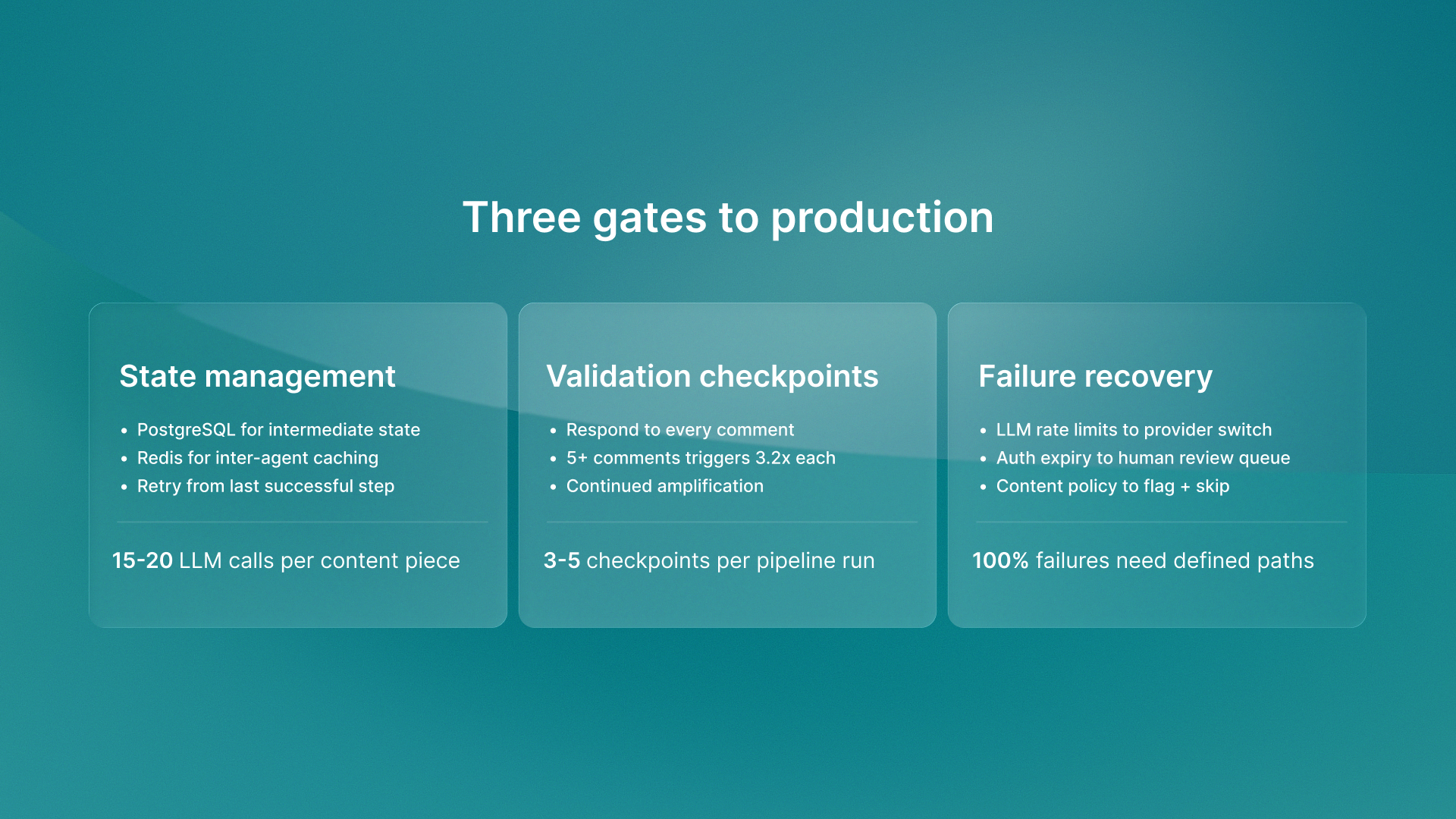
Production multi-agent orchestration requires coordination protocols, shared state management, and graceful degradation patterns. The difference between a demo and a shipped system depends on three things. Agents must share context. They must handle failures. They must keep results consistent across the AI content pipeline.
The orchestration layer complexity determines production readiness more than individual agent sophistication. Inter-agent communication, state management, and error handling separate demos from deployments. You can build five brilliant agents. But if they can't coordinate execution without manual intervention, you have five expensive prototypes.
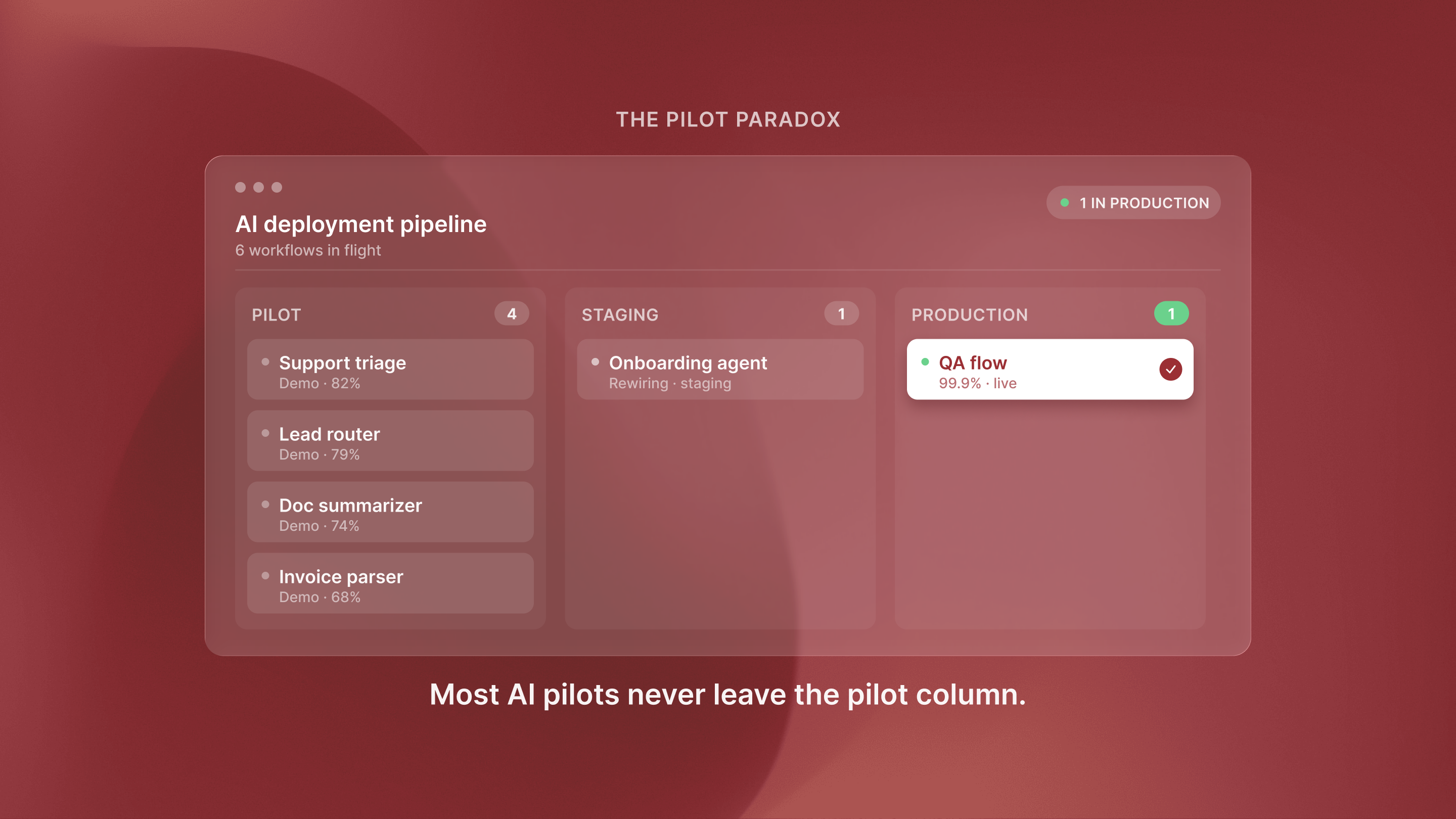
We covered orchestration patterns extensively when examining why agent projects stall between demo and production. Adopting proven patterns from day one reduces deployment time from 12-18 months to 8-12 weeks.
What the Islands deployment actually required
The Islands newsletter stack handles research aggregation, brief generation, draft composition, SEO optimization, and performance tracking autonomously. The multi-agent content system shipped in 8 weeks because we adopted proven orchestration patterns from day one. We used:
- Temporal for workflow management
- PostgreSQL for state persistence
- Structured LLM outputs for reliability
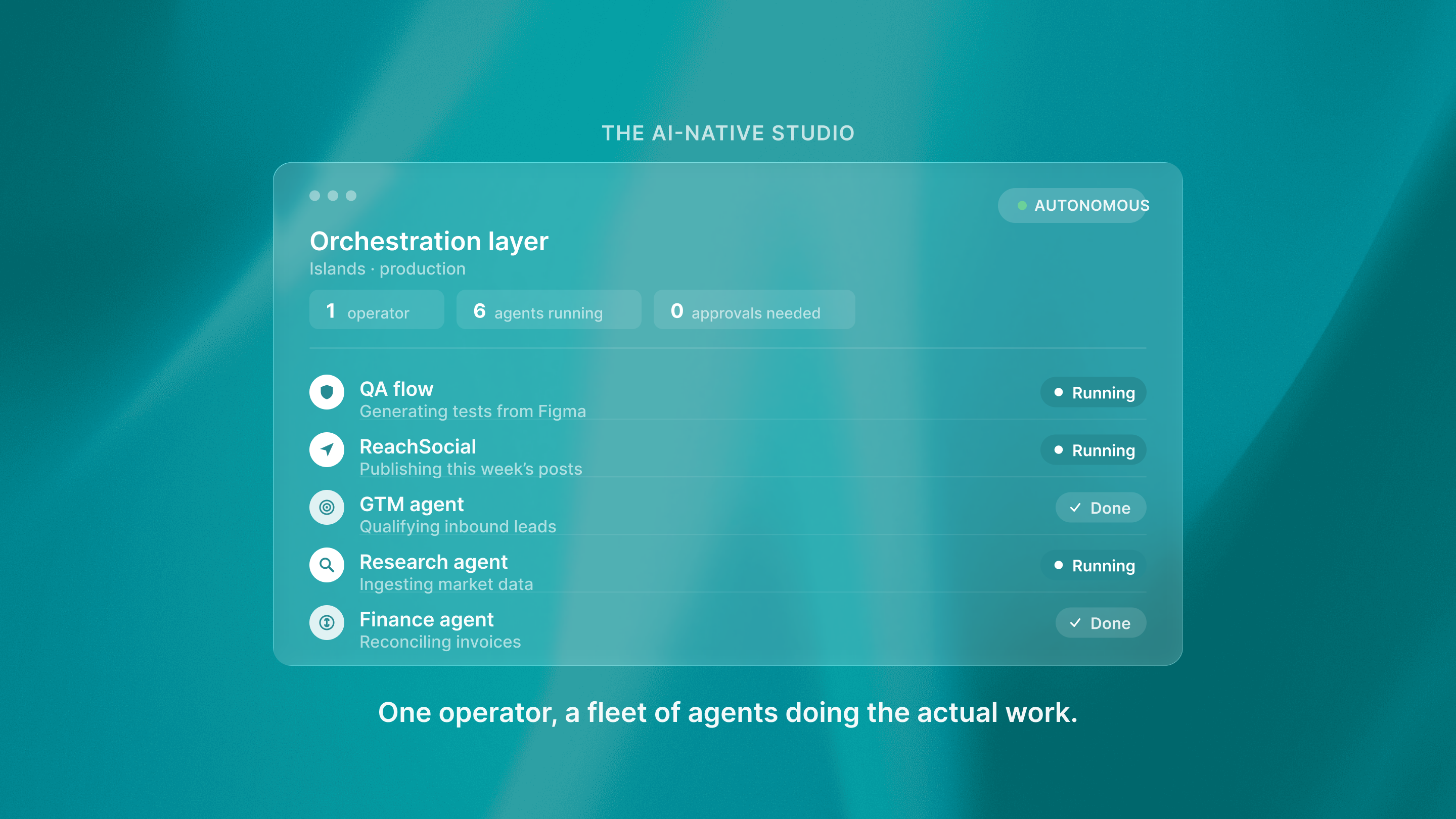
No manual handoffs between agents. No coordination meetings. The research agent finishes. It triggers the structure agent with validated data. That triggers the writer agent with a complete brief. Each stage has quality gates. Failed jobs retry automatically. State persists across runs.
The content agent architecture handles everything from identifying trending topics to publishing finished posts. The performance agent sends engagement data to the research agent. This creates a closed loop that improves content strategy over time. It does this without human analysis.
Cross-domain applicability proves the pattern generalizes
The same 5-agent pattern powers autonomous systems across domains:
- QA flow: Specialist agents for test case generation, execution monitoring, bug detection, and reporting
- ReachSocial: Agents for audience research, content drafting, engagement orchestration, and performance analysis
- Shoreline: Agents for ticket triage, response generation, escalation routing, and satisfaction tracking
Their LinkedIn automation workflow eliminates fragmented tool friction by integrating all stages into a single AI content pipeline.
The pattern generalizes beyond content to any workflow requiring sequential specialist tasks. The architectural principle holds. Specialist agents with orchestration protocols outperform general-purpose models attempting end-to-end execution.
This matters particularly for AI content automation at scale. Small businesses implementing AI tools for growth see quick productivity gains. But multi-agent content systems replace full workflows. They deliver compounding benefits, not just better single tasks.
The visibility shift from SEO to GEO changes everything
Content production speed matters less than citation probability. Generative engine optimization differs fundamentally from traditional SEO, requiring content optimized for AI citation through semantic depth and structured formatting. The multi-agent content system architecture naturally produces this structure.
The optimization agent doesn't just insert keywords. It structures content for machine parsing. It adds semantic markup. It creates citation-worthy fact clusters. That is why the same 5-agent stack works across Islands, QA flow, ReachSocial, and Shoreline. It works even with different content types and audiences.
AI-referred traffic grew 527% year-over-year according to GrowTal's analysis. Content systems optimized only for traditional search are building for yesterday's discovery layer.
Competitive timing matters more than perfection
The 5-agent pattern is emerging as the standard architecture for autonomous content systems in 2026. Organizations building single-agent or assistant-based approaches will need to rebuild when they hit scaling limits. The window for getting the orchestration layer right is 12-18 months before this becomes commoditized infrastructure.
Specialist agents are table stakes. Orchestration protocols are the differentiator. The gap between teams that ship production multi-agent content systems now and those that wait will grow fast.
Ready to build your own multi-agent content system? Start exploring production-ready architectures at Islands.
Success Stories
Read more


.svg)
