.svg)
How we use agents behind the scenes and humans in the loops for content

.png)
If you've watched AI tools churn out generic posts that your compliance team would never approve, the gap isn't the technology. It's the workflow. Last week, I was speaking with a fintech founder who was stuck in the typical agency cycle. They were paying $10,000 every month for a handful of blog posts that felt disconnected from their actual product. When they tried to use AI internally, the output was so hallucination-prone that their legal team shut it down within forty-eight hours. At Islands, we've found that the solution isn't better prompting. It's a fundamental shift in how you architect the pipeline.
Key results:
- 75% cost reduction : Replaced $10k/month agency fees with a $2,500 hybrid pipeline
- 3x volume increase : Scaled from bi-weekly posts to three high-fidelity pieces per week
- Direct integration : Content pulls from Fathom transcripts and internal docs for 1:1 accuracy
- Immediate ramp-up : First production pieces live within 4 days of integration
The agency gap vs. the hybrid AI content workflow
Traditional content agencies are built on human billable hours. This creates a natural ceiling on volume and a floor on price that usually sits around $10k per month for serious B2B SaaS teams. When agencies adopt AI, they often use it to cut their costs. They may still charge you the same premium for mediocre results. The model is broken because it prioritizes the agency's margin over your search and generative discoverability.
Here's the reality: a $2,500 hybrid agent pipeline consistently outperforms the traditional model. By running task-focused agents on Gemini and Claude, we can ship three pieces each week. We can publish them across channels like your CMS, LinkedIn, and Substack. This isn't about replacing humans: it's about shifting the human role from creation to orchestration. GrowTal has long supported an asset-first model. It helps remove slow freelancer ramp-ups. We have applied the same logic to AI. We provide the agents with the assets they need to be elite from day one.
.png)
Why the orchestration layer matters
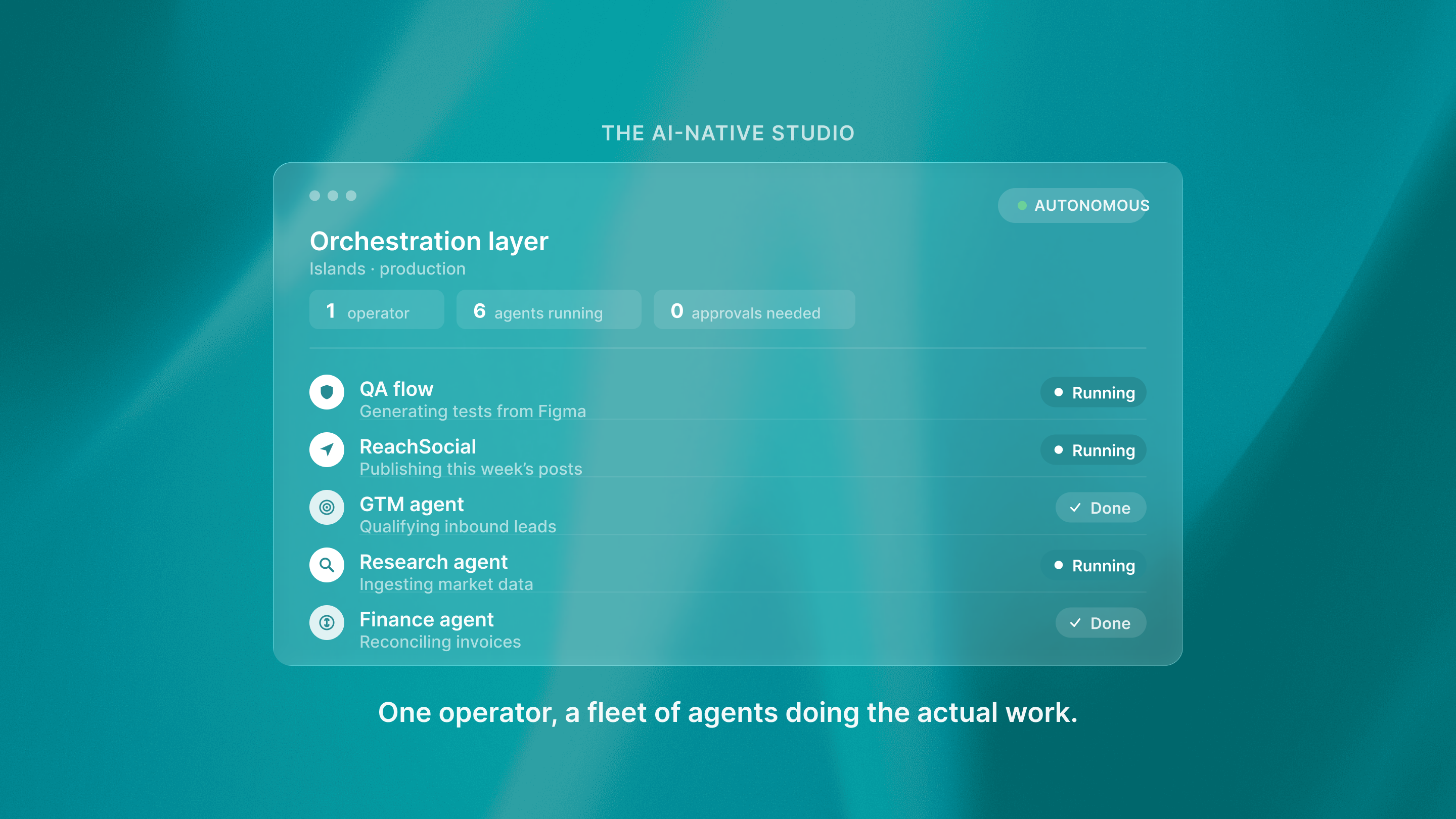
Most teams fail because they treat AI as a single text box. At Islands, we treat it as an architecture. We've seen that multi-agent content systems ship better results because they use explicit validation checkpoints. One agent might write the first draft. Another could act as a technical reviewer. This ensures the content sounds good and is correct.
Precision through validation
This architectural approach is the only way to maintain high accuracy at scale. Without it, you're just contributing to the noise. As we explain in our guide on why autonomous AI agents for news, these systems need careful upkeep. The same is true for B2B SaaS.
Solving context bleeding
If the agent isn't grounded in your specific reality, it will hallucinate. By using task-specialized agents, we solve the context bleeding and debugging problems that kill monolithic AI strategies.
Technical implementation: RAG over generic prompting
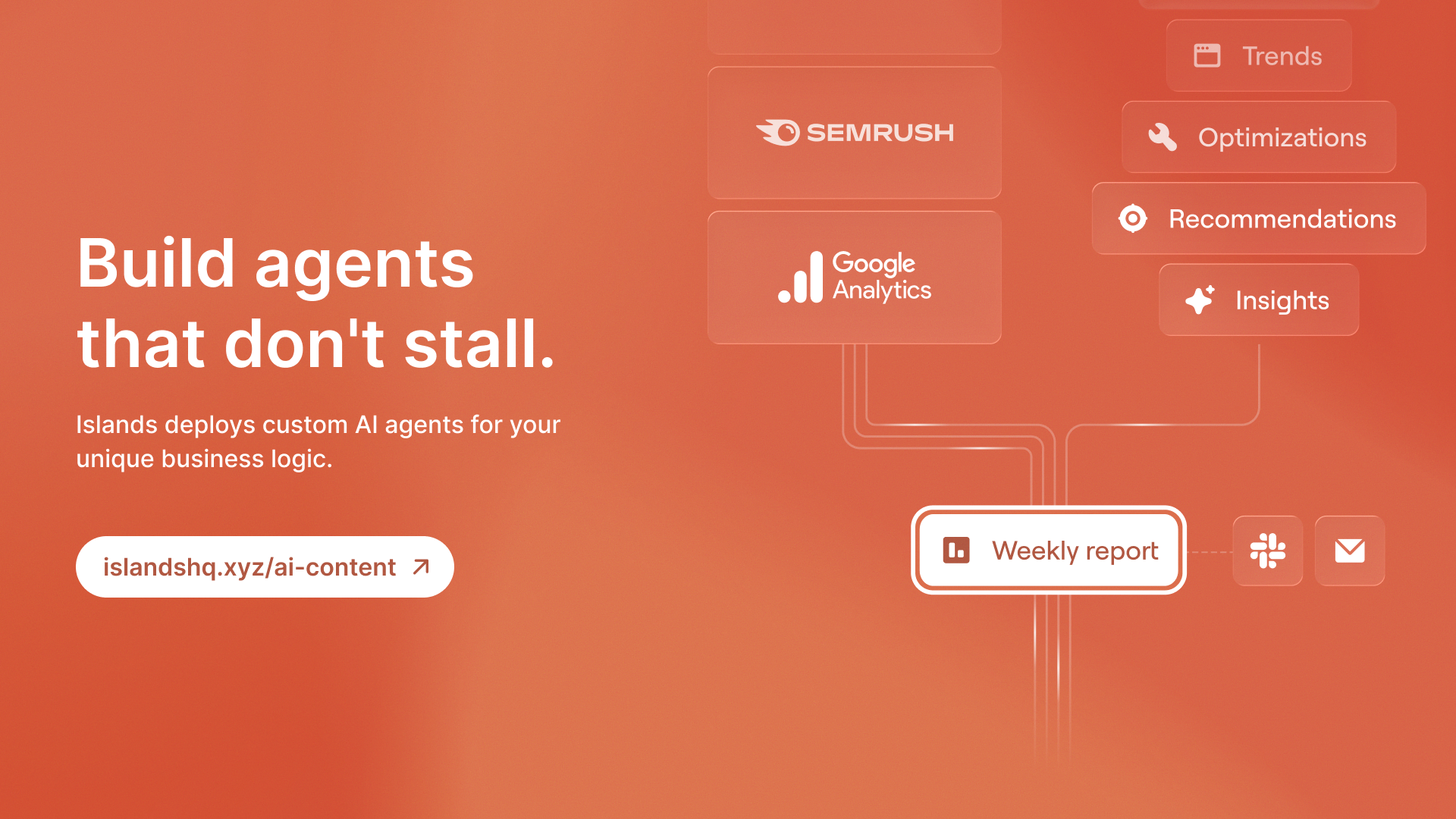
Generic AI content sounds generic because it relies on the model's training data. To get 1:1 personalization, you need Retrieval-Augmented Generation (RAG). Our agents integrate directly with your existing stack: Fathom recordings, Intercom knowledge bases, Notion docs, and Webflow. Instead of guessing what your product does, the agents reference your internal data to mirror your expertise.
We don't just write for Google. We write for the way people find information in 2026. Traditional SEO is about keywords: AI Search and GEO is about semantic depth and structured formatting. According to GrowTal, this approach is critical as AI-referred traffic grows 527% year-over-year. By building for generative engine optimization (GEO), we help your brand show up where new search engines find answers.
The human-in-the-loop AI compliance safety net
For a regulated fintech or healthcare startup, "close enough" is a disaster. Our human-in-the-loop AI model includes a multi-stage safety net. Agents handle fast, large-scale drafting, but a person on our team reviews every word before it reaches you. We then provide your compliance team with a dedicated approval status in the workflow.
This compliance-ready AI content approach removes the friction from legal reviews. Because the agents already use your approved internal docs and past blogs, their output matches your brand voice and rules from the start. We’ve seen this greatly cut time in the review-and-edit loop, where many B2B SaaS content strategy efforts fail.
Speed to market
One of the biggest bottlenecks in content marketing is the setup time. With our model, the first piece of high-fidelity content can be live within three to four days of tool integration. We don't spend months on discovery. We connect the agents to your data and start shipping immediately.
This speed is supported by tools like QA flow. We use them to keep our technical documentation stable. They also help keep our system architecture stable as we scale your content engine. I've found that why your AI strategy looks like 2010 software architecture often comes down to a lack of specialized orchestration. You can't solve new problems with old structures.
Auditing your workflow
If your current content process feels slow, costly, or too basic, you likely use a monolithic strategy that can’t scale. Autonomous content agents are becoming the go-to choice for high-volume B2B teams. They help teams move faster than a traditional agency can.
What we're seeing:
- Compliance is no longer a barrier if you build humans into the loop correctly.
- Direct data integration beats manual briefing every single time.
- Domain authority grows organically when agents can cite relevant portfolio data.
- A hybrid AI content workflow reduces costs while increasing output by 3x.
We back this approach with a 90-day guarantee on Google Analytics, Search traffic, and newsletter growth. This isn't a compromise. It's the only way to get the velocity you need without sacrificing the quality your brand demands. If you are ready to go beyond generic AI output, we should talk. We can review your current workflow. Then we can help you build a production-ready system.
Reach out to the team at Islands to schedule your content workflow audit today. Discover how our custom AI agents can transform your content pipeline into a high-fidelity growth engine.
Success Stories
Read more


.svg)
