.svg)
AI agents for marketing agencies: why architecture determines your competitive advantage


Workers who use AI daily are 64% more productive and 81% more satisfied with their jobs. Marketing agencies adopting AI agents see these exact gains. Agencies using AI assistants see incremental improvements to the same manual effort.
Here's the key point most agency leaders miss: 91% of marketers now use AI at work.That's up from 63% just one year ago. But most implementations are ChatGPT wrappers and AI assistants. They enhance existing workflows instead of fully replacing them with autonomous agents. This isn't about whether to adopt AI - that decision is made. It’s about whether you design for upgrades or replacement. This choice decides if AI becomes a competitive edge or just a productivity tool.
The difference isn't philosophical. It's economic, with specific productivity and ROI outcomes tied directly to your architecture decision.
AI assistants enhance productivity, AI agents replace workflows
AI assistants work within your current processes. They help copywriters draft faster, assist account managers with client emails, and speed up reporting tasks. The workflow remains the same - humans still execute, review, and iterate. Productivity improves incrementally, but the economic model stays intact.
AI agents for marketing agencies operate differently. They replace full workflows with autonomous systems that manage content creation, campaign optimization, and performance reports end to end. At QA flow, our autonomous testing agents don't assist human testers - they execute complete test cycles without human oversight. The same architectural pattern applies to marketing workflows: agents see context, make decisions, take actions, and learn from results. They do this without needing constant human help.
This creates fundamentally different economic outcomes. When Islands analyzed workflow automation across our portfolio, we found that assistant implementations still scale linearly with headcount. Agent implementations scale exponentially because they operate autonomously once deployed.
The market is shifting faster than most agencies realize
By 2026, 40% of enterprise applications will feature task-specific AI agents, up from less than 5% today. That's an 8x increase in 12 months, signaling a massive shift from enhancement to replacement. Marketing agencies that architect for agents now will have multi-year competitive advantages over those still using assistants.
The gap between AI usage and AI transformation is enormous. Enterprise adoption of task-specific AI agents remains under 5% despite 91% of marketers using AI daily. Most agencies are using AI to work faster, not differently. This creates opportunity for leaders who understand the architectural distinction and act before competitors recognize what's happening.
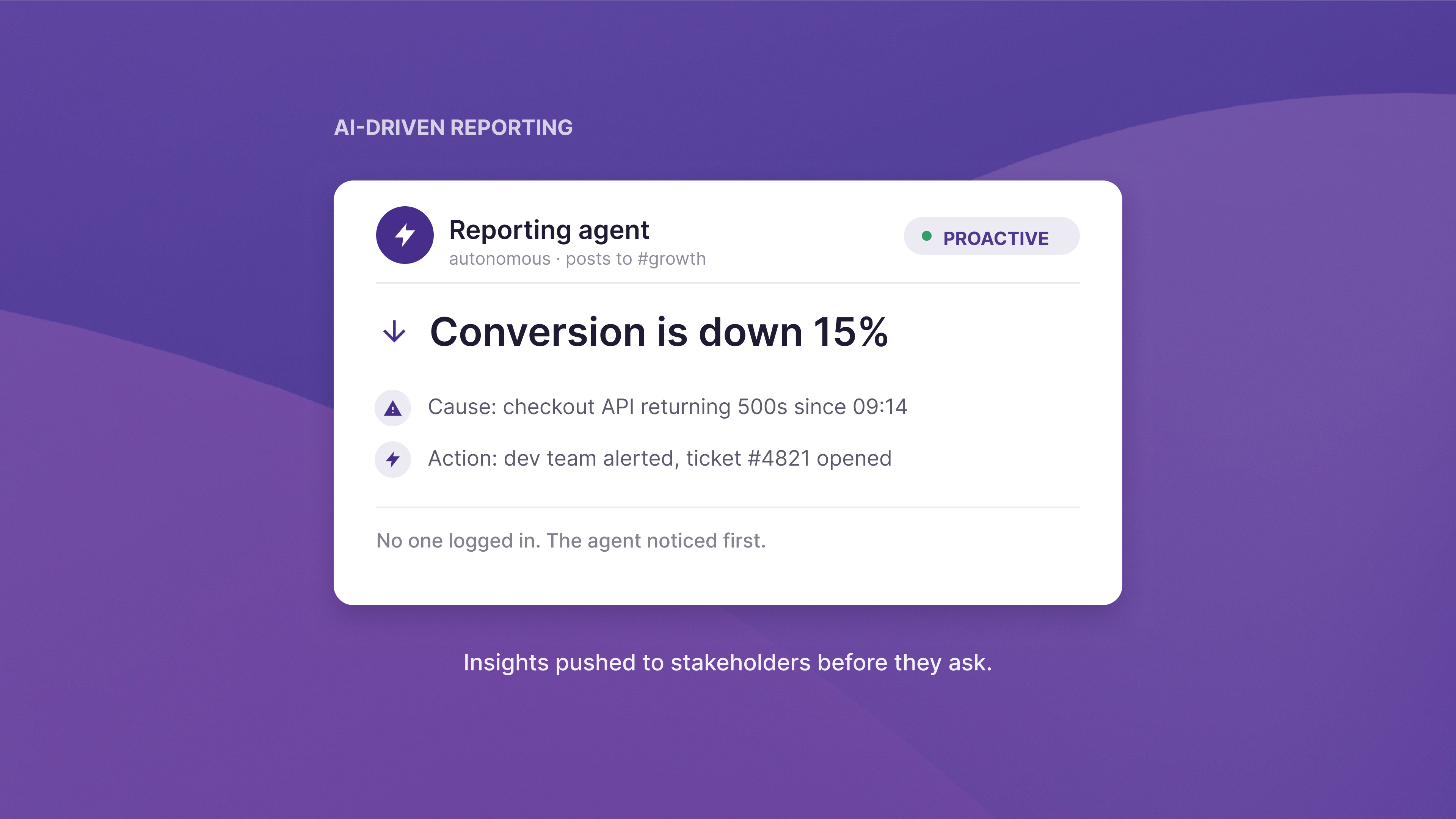
Marketing workflows offer unique chances for automation that agents can handle fully. Content calendars can adjust based on performance data. Campaign optimization can run nonstop without human oversight. Client reporting can generate insights and recommendations on its own. Assistant implementations in these areas still require humans to execute final steps, review outputs, and make decisions. Agent implementations handle the complete cycle.
.png)
Why the architecture decision can't wait
Retrofitting AI assistants into AI agents requires complete rebuilds, not incremental upgrades. Agent architecture needs perception layers that watch many data sources. It also needs reasoning engines that weigh options and make decisions. It needs action executors that apply changes in your systems. It also needs learning loops that improve performance over time. Assistants never need these components because humans handle perception, reasoning, and learning.
Adding these capabilities post-launch means starting over. The infrastructure, data pipelines, and system integrations are fundamentally different. We've seen this pattern across deployments at QA flow, ReachSocial, and other systems. The architecture choice is a one-way door. Foundational decisions shape what is possible later.
Most agencies are making this decision right now without understanding the tradeoffs. They're implementing AI assistants because the lift seems manageable and the ROI appears immediate. But when competitors deploy agents that operate autonomously at scale, those assistant implementations become technical debt that requires expensive rewrites.
The reality of autonomous marketing operations
The productivity data tells the story: 64% gains come from workflow replacement, not task enhancement. When marketing agencies build for autonomous agents, not just helpful assistants, they gain the same rapid improvements. We’ve seen these gains in autonomous testing, engagement automation, and compliance monitoring.
The question isn't whether AI will transform marketing agency operations. The question is whether your architecture decision helps you capture that change or forces a rebuild when the market shifts. By 2026, agencies running on agent-native architectures will be competing in a different category entirely.
Success Stories

.svg)
