From one usable ad brief in ten to thirty a week

~90%
Of brief-writing effort binned before review
30/wk
Structured briefs written into Notion weekly
18
Brief agents in parallel across six products
TL;DR
Growth Stackers’ creative director wrote more than ten AI ad briefs to keep one, then pasted each survivor into Notion by hand.
We rebuilt the prompts inside Triple Whale and moved parsing and delivery into n8n, writing every brief to Notion through its API.
Thirty structured briefs now land in Notion every Monday, from 18 brief agents across six products.
Growth Stackers runs creative on a Meta account carrying roughly 50,000 live ads at any one time, generated and scored through Triple Whale’s Moby. At that volume, testing velocity is the whole game, and the constraint was how many usable ad briefs reached an editor each week. Thirty structured briefs now arrive every Monday morning, and the review that used to be a rewrite is now a read.
The challenges
Two jobs on the creative side were done entirely by hand, and both sat directly in front of testing velocity.
Nine briefs in ten went in the bin
Triple Whale’s built-in brief agents pulled ad performance data with SQL, but the raw output meant writing more than ten briefs to keep one.
Every surviving brief was carried across by hand
Briefs went into Notion one at a time. Notion blocks do not support tables, and a table was the core requirement.
Ad production meant retyping the winners
Headlines from ads above $1,000 spend and under $50 new-customer acquisition cost were retyped into Figma templates by hand.
What we built
Generation stays where the data is: the SQL pull and the prompts run inside Triple Whale. Parsing and delivery moved into n8n, where they can be read, debugged and changed. One scheduled job has run the chain at 8am Eastern every Monday since the week of 9 March.
Rewriting the prompts where the data lives
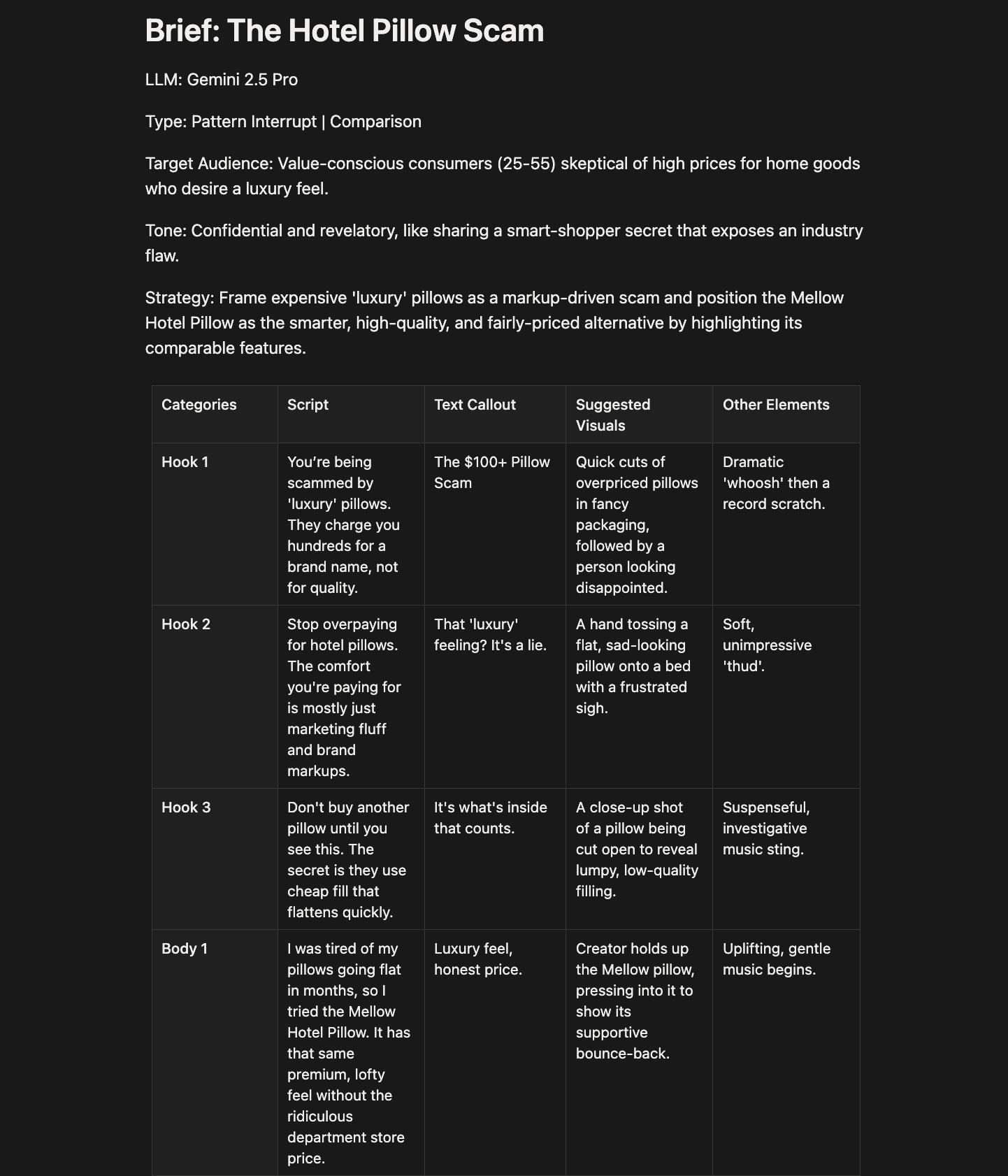
Parsing loose text into a table the team can work in
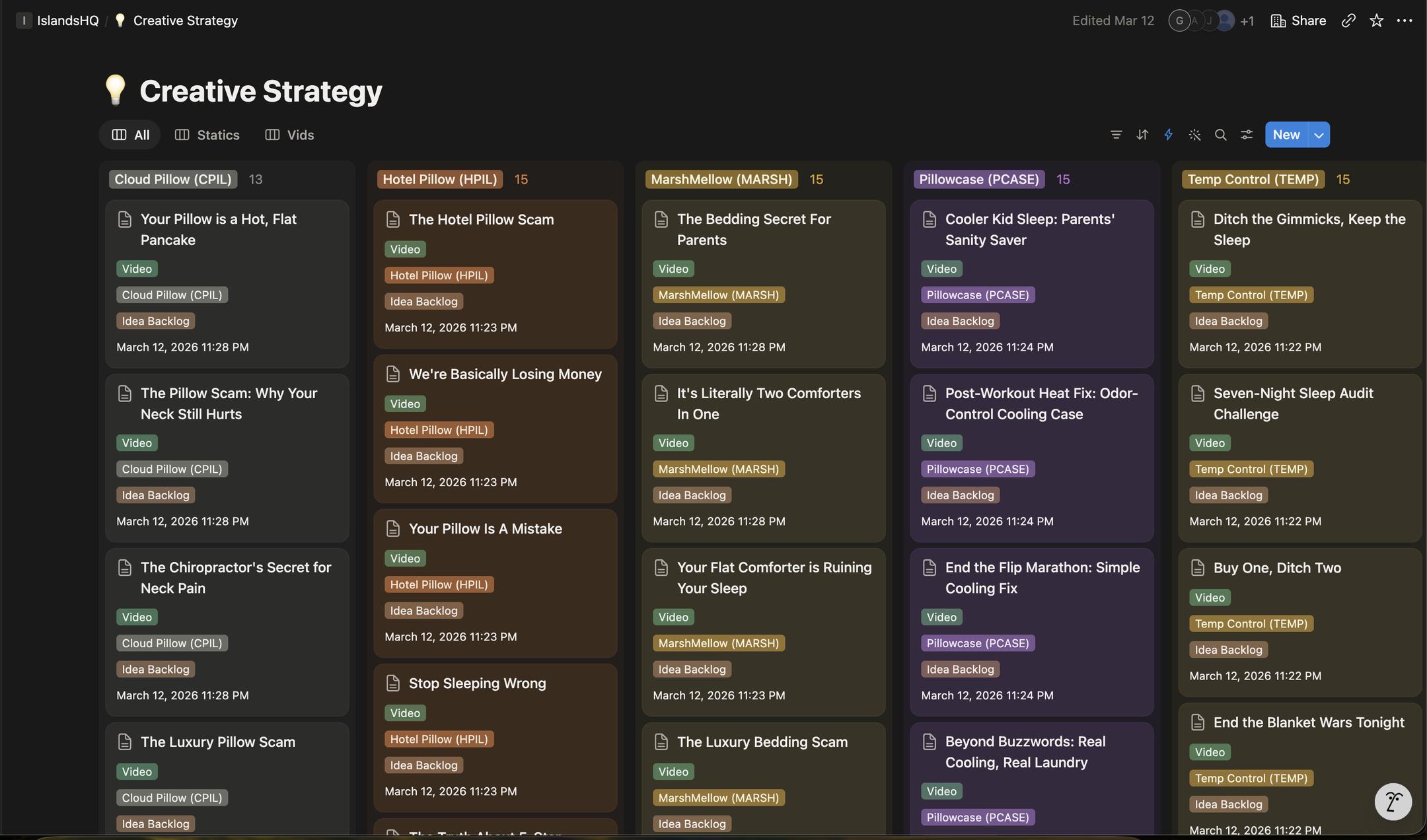
Three models per product, then deprecate
Two proofs of concept

Conclusion
Brief usability went from roughly one in ten to effectively every brief arriving on brand and editor ready, with the manual copy step gone. The pattern is portable: keep the vendor tool to the one step it owns, and move prompting, parsing and delivery somewhere debuggable.
Want your vendor AI output landing somewhere usable? Get in touch.
~90%
Of brief-writing effort binned before review
30/wk
Structured briefs written into Notion weekly
18
Brief agents in parallel across six products
Generation: Triple Whale agents, SQL over ad performance data, Moby | Models: GPT-5, Claude, Gemini
Orchestration: n8n, one scheduled run weekly at 8am ET Monday
Destination: Notion database via API, one row per brief, Idea Backlog through to Ready to Edit
Status: brief automation live since the week of 9 March; Figma replacement and campaign generator are proofs of concept
FAQ
How do you automate AI ad briefs from Triple Whale into Notion?
Keep the SQL pull and prompts in Triple Whale, receive the output in n8n, parse it into an array of briefs, and write each one through the Notion API as a database row.
Why move parsing out of the vendor tool?
Triple Whale sends text rather than JSON, its webhook exposes only the URL, and its agent builder is hard to debug. n8n can be read, debugged and changed.
How do you choose between GPT-5, Claude and Gemini?
Run all three per product, tag every brief by model, and cut back to the winner on real work rather than a bake-off.
Can AI fit winning ad copy into fixed Figma templates?
Only as a proof of concept here. Per-layer character counts, meaningful strikethrough and non-headline fields make it close to intractable without image processing. More on AI agents for marketing agencies.
Read more