.png)

Building a fully automated creative pipeline from the ground up
.png)
.svg)
.svg)
.svg)
.svg)
.svg)

Growth Stackers aimed to identify and implement workflow improvements through the strategic use of AI and automation. The objective was to optimize operational efficiency, minimize time spent on manual tasks, and reduce overall costs. In addition, the company sought to enhance the performance of its existing AI systems by refining prompts to improve the accuracy and reliability of generated outputs.
Hrs → Mins
Creative production time per campaign
10-20x
Variations generated per product without designer involvement
Six figures
Ad spend managed through the automated pipeline
The gap
The client is managing a vast volume of historical data and operating at an ad spend of six figures per day. Given this scale, prompt optimization was critical to ensure highly accurate and reliable AI-generated results. Additionally, with such a high volume of ads running daily, any manual process, when multiplied across campaigns, resulted in significant operational delays.
At the time, their UGC content workflow relied on analyzing older video assets to generate new creative briefs. These briefs were then manually added to a Notion database and assigned to editors and creators, creating bottlenecks and limiting scalability.
Content automation
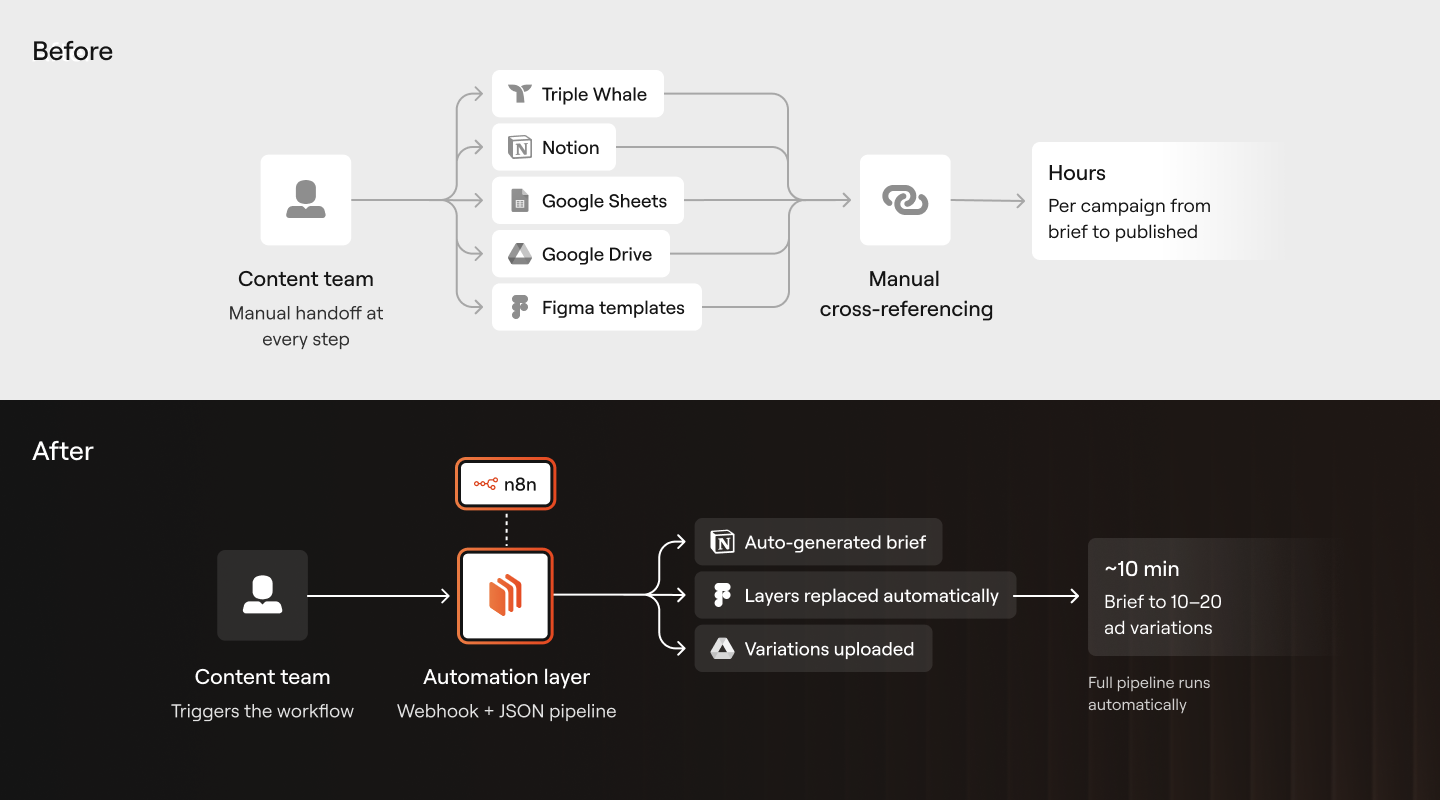
We began by conducting a deep audit of GrowthStackers’ existing setup across Notion and Triple Whale. This included reviewing how their AI agents generated creative briefs in tabular format, which were then manually copied into Notion and adjusted before being assigned. Identifying these friction points allowed us to pinpoint where automation could create the greatest impact.
From there, we designed and proposed a scalable automation architecture. We introduced n8n as the orchestration layer and restructured the Triple Whale agent outputs to generate clean, structured JSON instead of table-based text. This was a critical upgrade—it transformed static output into machine-readable data that could power a fully automated workflow.
Using a webhook triggered directly from the Triple Whale agent, the JSON payload was sent to n8n, where we applied structured formatting and validation. We then leveraged the Notion API to automatically generate a new page within Notion—eliminating the need for manual copy-pasting entirely.
During this phase, additional notes were shared highlighting that the improvement wasn’t just about automation — it was also about the quality of the generated results themselves. Based on that, we refined and restructured the AI prompts to ensure the output was fully aligned with the customer’s needs and delivered the best possible results.
Each brief was dynamically structured around a consistent set of components — title, type, audience, tone, and strategy — followed by a Content section broken into three elements: hooks, body, and CTA. Each of those elements was formatted as an object containing a script, text callout, suggested visuals, and other elements.
By replacing repetitive manual tasks with a fully automated pipeline, we dramatically reduced turnaround time, minimized human error, and built a scalable system capable of managing high ad volumes without creating operational bottlenecks.
Advertisement generation automation
The company’s ad production workflow was fully manual. Designers would open Figma templates, retrieve headlines from a Google Sheet, update text layers individually, export each variation, and upload final creatives to Google Drive. As campaign volume increased, this process became time-consuming, repetitive, and difficult to scale.
We designed and built a custom Figma plugin to automate the workflow end-to-end.
The solution
• Reads structured headline data from a centralized Google Sheet.
• Identifies the correct ad templates within Figma.
• Generates multiple variations per product automatically.
• Replaces predefined text fields based on consistent layer naming rules.
• Exports all creatives in the required format.
• Uploads finished assets directly into organized folders in Google Drive.
To ensure reliability, templates follow strict naming conventions so text mapping is always accurate, pages are organized by product category to avoid conflicts, and generated files follow a standardized naming structure for traceability. The system supports bulk generation (e.g., 10–20 variations per product) without designer involvement.
The result cut creative production time from hours to minutes, eliminated manual errors, and freed up design resources for higher-value work, while introducing a scalable process for launching and testing campaigns faster.
Hrs → Mins
Creative production time per campaign
10-20x
Variations generated per product without designer involvement
Six figures
Ad spend managed through the automated pipeline
Suggested stories
.png)
.png)
.png)
.svg)
