
Achieving 5x faster client reporting with AI agents

~96%
Reduction in per-report time, per client
$335/mo
Saved by stopping the Fluent.ai subscription
100%
Consistency across reports in format and tone
TL;DR

Twenty-First Digital spent hours each week building client performance reports by hand, with no benchmarking system and no single source of truth.
We built a per-client knowledge base in Claude Projects and connected live campaign data through Databox's MCP server, with an analysis engine for pacing and benchmarks.
Per-report time dropped by about 96%, every report keeps each client's voice, and a $335/month subscription was retired.
Twenty-First Digital manages paid media campaigns for 25+ publisher clients across regional magazines and national publications. It needed to eliminate hours of weekly reporting while improving consistency and quality.
The goal was an automated AI agent system that creates client-ready performance reports, analyzes campaigns against past baselines, and keeps each client's tone and context.
The challenges
The manual process was broken at every level.
1. Manual data entry for every report
2. No benchmarking system
3. No single source of truth
Client profiles and tone preferences lived in team members' heads and scattered email threads, making consistency difficult.
What we built
1. Knowledge base architecture
We built a knowledge base in Claude Projects, one dedicated instance per client, each holding a campaign reference (goals, budgets, flight dates), 2+ years of historical benchmarks from Databox organized by campaign type, a client profile and tone guide, and a report format template.
Benchmarks varied dramatically: some campaign types performed 3 to 4× better than others, so averaging them created meaningless baselines. Benchmarks were segmented by campaign objective, publication type and audience. Everything is stored as markdown, so AI can query it instantly and the team can edit it.
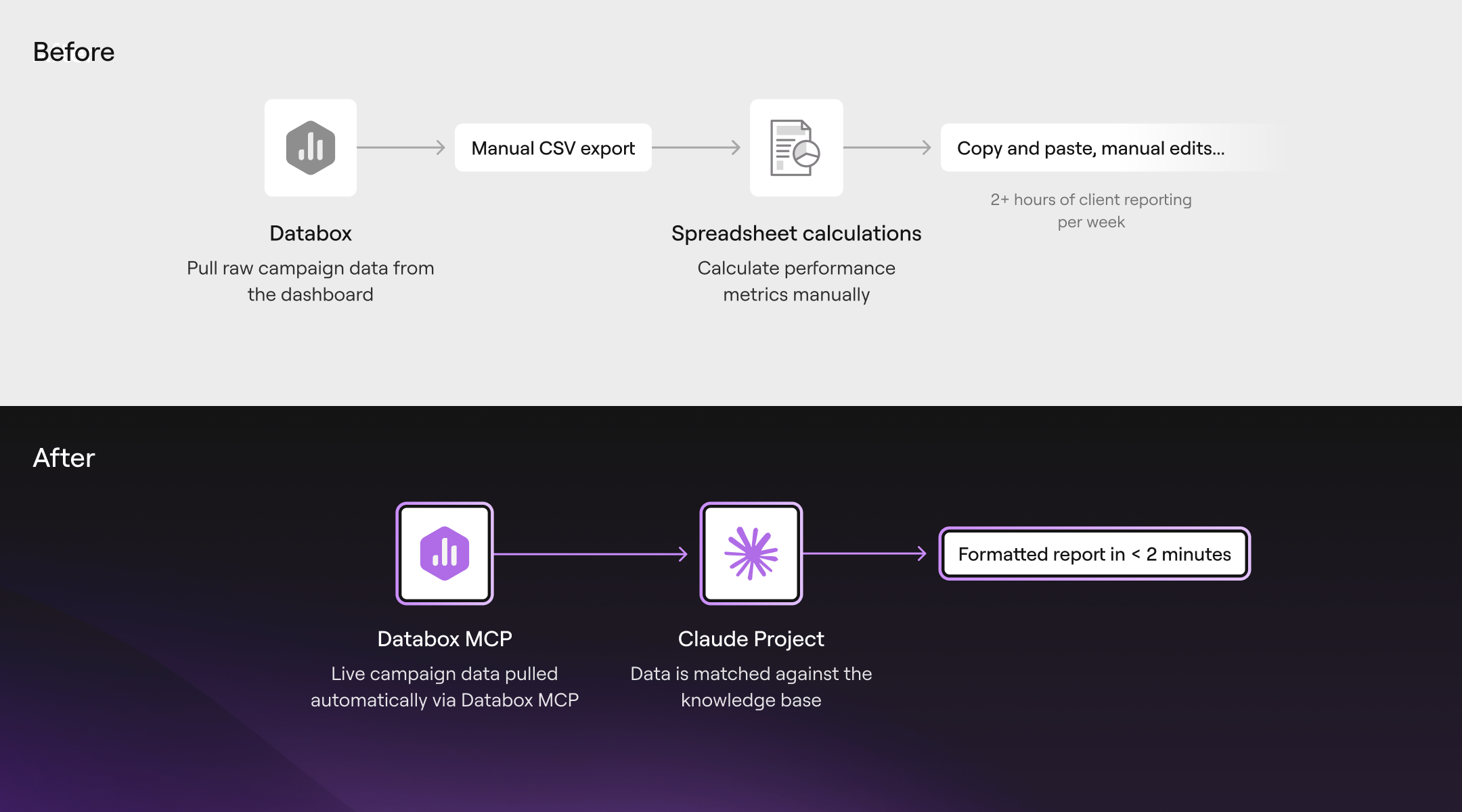
2. Live data integration and analysis
Databox's MCP server pulls real-time campaign metrics, historical trends and custom calculated metrics. The analysis engine calculates pacing status (on track, at risk, off track), compares performance against benchmarks, adds client-specific context, and adjusts tone for internal or client-facing reports. Instead of "this campaign cost $X," it answers whether that is good or bad for this campaign type, this client and this history.
3. What's next
Rolling the system out from the two-client pilot to all 25+ clients, adding daily monitoring with Slack alerts for pacing problems, budget overruns and anomalies, and technical SEO audits for publisher clients using QA flow.
Conclusion
Beyond the time and cost savings, the system solved the institutional knowledge problem: historical context is pulled automatically, CPL benchmarks are quantified by campaign type, and every report keeps each client's voice regardless of who runs the account.
The lessons: hybrid data architecture beats pure API use, API limits need creative solutions, domain-specific beats generic tools, and starting small proves value before scaling. Get in touch.
~96%
Reduction in per-report time, per client
$335/mo
Saved by stopping the Fluent.ai subscription
100%
Consistency across reports in format and tone
Use case: AI agents, marketing, content | Industry: audience growth
Knowledge base: Claude Projects, one per client, markdown documents
Live data: Databox MCP server | Analysis: pacing thresholds, segmented benchmarks, tone control
Pilot: 2 clients, rolling out to 25+
FAQ
How do you automate client reporting for a marketing agency with AI?
Give each client a knowledge base of campaigns, benchmarks, tone and report format, connect live metrics through an MCP server, and let an analysis engine judge pacing and performance against segmented benchmarks.
Why combine a knowledge base with live API data?
Hybrid architecture is more reliable than pure API use and easier to audit, update and troubleshoot when issues arise.
How much time does automated reporting save?
About 96% of per-report time per client, from over two hours of weekly reporting to formatted reports in under two minutes.
Why not use a generic reporting tool?
Off-the-shelf tools could not encode client-specific context, past benchmarks and communication needs. See AI agents for marketing agencies.
Databox MCP,
Slack

Read more


