
We 10x'd inbound traffic with AI Content Agents
6 → 1,266
Subscribers on the Islands newsletter on Substack
7 → 1,233
Subscribers on the QA flow newsletter on Substack
35,727
Total organic impressions on LinkedIn
TL;DR

Islands needed consistent thought leadership across several ventures without hiring a writer per brand or losing its voice to outsourcing.
We built an n8n-orchestrated pipeline of four specialized AI agents (strategy, research, master writer and channel sub-agents), connected to Semrush through MCP.
In 180 days with no paid ads, the Islands newsletter grew from 6 to 1,266 subscribers and the QA flow newsletter from 7 to 1,233.
Most content strategies die in a doc. Ours went live. In December 2025, Islands launched its own AI content system: a multi-agent workflow built on n8n that turns business context into published, platform-ready content.
No freelancers, no content managers, no editorial bottlenecks. The same engine now runs as our AI Content Agency for clients.
The challenges
The question was not whether to invest in content. It was whether content could run itself.
1. Several ventures, one team
2. Hiring per brand does not scale
3. Outsourcing loses the voice
Each builder has a unique story to tell through client work, and outsourcing meant losing it.
The system
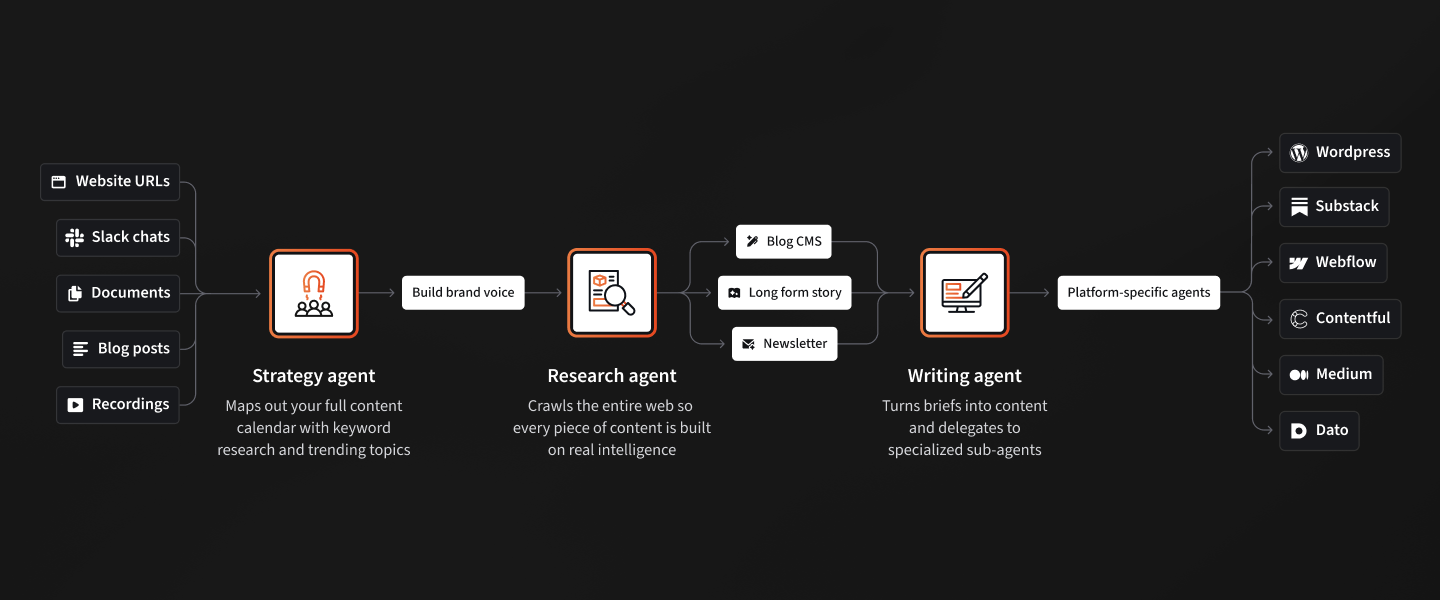
An n8n-orchestrated pipeline with four specialized agents working in sequence, connected to Semrush through MCP for keyword data, competitor intent and traffic trends. It publishes for QA flow, Shoreline and ReachSocial alongside Islands' own Substack and Medium: one system, four brands, zero extra headcount.
1. The strategy agent
Ingests company docs, competitor URLs, meeting transcripts and brand exemplars, finds keyword opportunities, content gaps and trending topics through Semrush, and builds a full content calendar.
2. The research agent
Explores each topic with real-time web research across Reddit, X and Hacker News plus competitor analysis, so every piece starts from a research brief.
3. The master writer agent
Turns briefs into platform-ready content with brand voice, hooks and SEO structure, including meta title, meta description and image alt captions for SEO and AEO, then delegates to channel sub-agents.
4. Channel sub-agents
Publish long-form content to Medium and CMS platforms, send newsletters to Substack, and share LinkedIn posts through ReachSocial, with posts created and segmented in Notion via API.
Conclusion
All growth was organic. The Islands newsletter went from 6 to 1,266 subscribers (+21,000%) and 295 to 10.8K views. The QA flow newsletter went from 7 to 1,233 subscribers and 124 to 11K views. QA flow's LinkedIn reached 35,727 organic impressions, peaking at 8,300 a month.
The system is now available to companies that want to stop treating content as a bottleneck. Get in touch.
6 → 1,266
Subscribers on the Islands newsletter on Substack
7 → 1,233
Subscribers on the QA flow newsletter on Substack
35,727
Total organic impressions on LinkedIn
Orchestration: n8n, AWS
AI models: Claude Sonnet 4.5 (strategy and writing), GPT-4 (research fallback)
Integrations: Semrush MCP, Ahrefs, Webflow, WordPress, Substack, Medium, Notion, Slack
FAQ
How does a multi-agent AI content system work?
A strategy agent builds the calendar from company context and Semrush data, a research agent writes briefs, a master writer agent drafts with brand voice and SEO structure, and channel sub-agents publish to each platform.
Can AI content agents keep a brand's voice?
Yes. The system ingests websites, past posts and product documents, and the more context it gets, the more it sounds like the brand.
Can AI newsletter automation grow subscribers?
Yes. In 180 days with no paid ads: 6 to 1,266 Islands newsletter subscribers, 7 to 1,233 QA flow newsletter subscribers and 35,727 organic LinkedIn impressions.
What tools power the pipeline?
n8n and AWS for orchestration, Claude Sonnet 4.5 and GPT-4, and Semrush MCP, Ahrefs, Webflow, WordPress, Substack, Medium, Notion and Slack. See what content automation is.
Claude Sonnet 4.5, GPT-4
Semrush MCP

Read more


